Easter in Slovakia: Easter eggs and buckets of cold water
It’s not Easter bunnies or chocolate eggs hiding in a bush. In Slovakia, Easter Monday used to be celebrated by guys chasing girls around with a whip (a switch) made from willow branches (korbáče) and pouring buckets of cold water on them. And as a sign of gratitude, girls rewarded the boys by giving them beautiful hand-decorated Easter eggs, chocolates, liquor, or even money. What an awesome traditions!
Ok, perhaps some girls will disagree with me. But this tradition of šibačky (switching) and polievačky (watering) is all in good sport. The point was not to cause harm, instead, this tradition kept the girls beautiful and “springy” (like the twigs) for the whole year. And of course, it gave the boys a chance to visit their favorite girls.
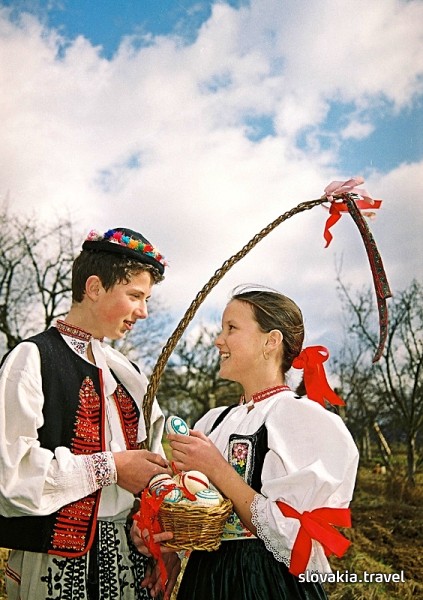
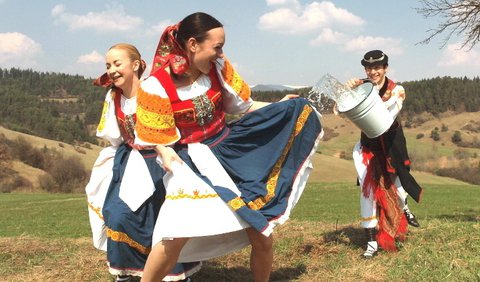
Images from the traditional way to celebrate Slovak easter. The first image comes from Slovakia.travel, the second image was submitted on Facebook.
Traditional Slovak Easter celebrations date to the pre-Christian pagan times, when people did not think of seasons changing as something happening automatically due to the Earth’s orbital motion. Instead, the seasons were directly linked to the spirits present in the environment all around them. Spring was the time when the good spirits started taking the lead from the evil that dominated through out the winter. And to aid in this transition, several rituals were undertaken to help the good defeat the evil. There was the drowning of Morena (potápanie Moreny) in which a wooden board decked in women’s clothes was sent floating down the river. This symbolized getting rid of bad things from the previous year. There was also the raising of the May pole (stavanie mája), which was a green budding branch, decorated with colorful ribbons and Easter eggs. This again symbolized the coming of Spring and was meant to surely put the Winter behind.
In fact, green budding twigs were believed to have magical powers, and that’s where the tradition of Easter whipping comes from. By getting switched by the spring branch, the girl would receive not only some of the strength from the guy, but also the health, liveliness, and fertility of the budding branch. It was believed that girls who got whipped would get younger, become prettier, and also more skilled in their daily doings. No wonder that it was a truly bad omen for some girl not to receive any switching! Of course, the guys were more interested in visiting the prettier of the bunch, and this is why some girls had to resort to bribing the guys by offering them presents: Easter eggs, home baked goods, bacon, and so on. Each guy also received a colorful ribbon from each girl to tie to the end of his korbáč (the decorated easter whip). At the end of the day, young boys and girls gathered for a party, and the boy with most ribbons became the king of the night.
The pouring of water had a similar rejuvenating meaning. The water washed away all the evils and diseases from the body. In some villages, guys would throw girls in a nearby creek. In most, cold water was pulled from the well and poured onto girls from buckets.
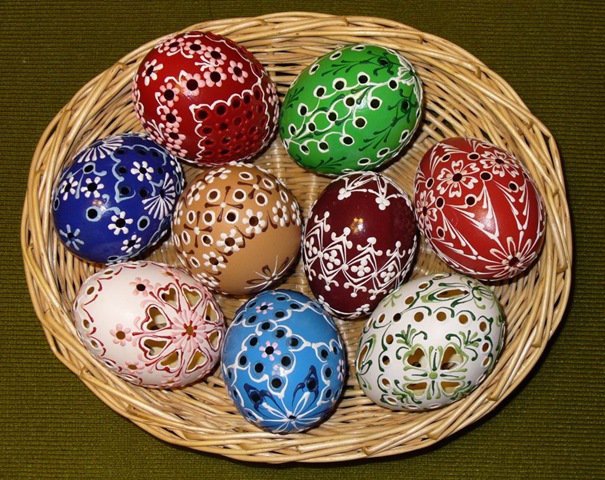
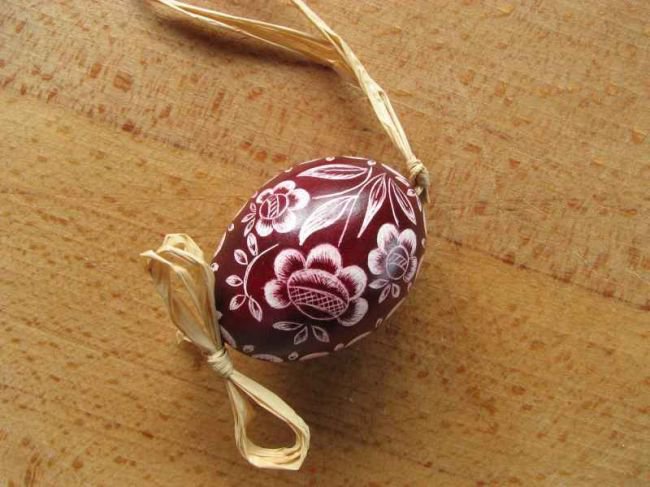
Few examples of traditional Slovak Easter eggs mailed in by readers.
These days, the Easter Monday traditions are still widely followed but in a somewhat modernized manner. Many girls still wake up Easter Monday by having a bucket of water poured on them while still in bed. But the general polievačka now consists of merely a cup of water splashed in the girl’s face. And for good measures, the guy the sprays some perfume on the girl. And while in the past it was customary to only switch the younger generation, now the tradition has extended to the whole family.
But what about food? Easter Sunday was a day for bountifulness, and in many families, it was eggs and ham and that became a popular Easter Sunday dish. In my family, we celebrated Easter Sunday by a plate full of open face sandwiches and deviled eggs. Other families also prepared braided raisin bread vianočka), potato salad and baked ham. In the East, it was common to make something called hrudka, which is a “cheese” made of eggs, and also pasha bread. Young ram, baránok, was another symbol of spring. Those families that could not afford to have an actual lamb meat, prepared dishes in the shape of a young ram.
Regardless how you decide to celebrate it, happy Easter to you!
Good references on the traditions of switching
http://spectator.sme.sk/articles/view/5179
http://spectator.sme.sk/articles/view/407
http://hnonline.sk/c1-36706340-velkonocne-sibanie-pochadza-z-predkrestanskeho-obdobia
http://www.sme.sk/c/3790349/sibacka-mala-pozitivny-vyznam.html
Easter Traditions
http://www.infovek.sk/predmety/etika/tradicie/vn/vnzvyky.php
http://www.velikonoce.org/velikonocni-tradice/
http://suraba.blog.sme.sk/c/190268/Velkonocne-tradicie.html
http://www.jankohrasko.sk/clanky/clanky/2008/marec/velkonocne-tradicie-a-zvyky
Easter Egg Decorating
http://www.infovek.sk/predmety/etika/tradicie/vn/techniky.php
http://www.nasarodina.sk/article.php?sid=1487
http://www.velikonoce.org/velikonocni-kraslice/
http://www.slovakia.travel/entitaview.aspx?l=1&idp=6606
How do you celebrate Easter in your family?
When my wife was a girl in northern Slovakia, her family’s Easter lunch had ham, horseradish (not spicey), hardboiled eggs, and a cake in the shape of a lamb (berancek). Yesterday I had the same for our lunch. She also said they always took a trip to the mountains on Easter Monday to avoid the water and whips.
Actually, there is a lot of misunderstanding around ”easter;; in Slovak Republik.
As a matter of fact, no lamb would be eaten.
In the past meat used to be rather expensive and NO FARMS actually existed to produce either meat or milk.
That is not entirely true – my grandmother was from Kosicka Bela,Sk they had a farm they sold/traded milk & eggs etc… My grandmother never mentioned this whipping and water throwing tradition, I wouldn’t like like that myself. My entire family cooks for Easter I think in some ways it’s bigger then Christmas.
Also celebrating the ”PASKA” which is almost during the same period as PASSOVER, shows, that it would be rather jewish than catholic celebration.
LOL I love it… I think that would be so much fun. I don’t know about you… but i’m not even hungry today after all the food that we ate yesterday.
between the paska..perogy…tenderloin
and of course birthday cake..
Hope you guys had a Happy Easter.
Hi Dianne. It is fun for the guys. Women in the last few decades started to run away from this tradition. Even my mother told me today, after I announced that I would pour water over her after work: “Don’t you dare!” 🙂
After Christmas, Easter is probably the most popular holiday in Slovakia. The article above is pretty much what I have experienced and have a lot of great memories about it;)
There are real problems.
How to support the asocials, good investment, religious misunderstandings…
Can someone please give me a recipe for hrudka? My husband’s mom made it at Easter.
Thanks
Georgia
Georgia, we never made this in my family (I think it’s more of an eastern Slovakia thing). You will find a recipe on the It’s All Relative website, http://www.iarelative.com/recipe/e_cheese.htm
Hrudka (or Sirok, Sirets, or one of many other possible names depending on where in Eastern-Central Europe you are or your ancestors came from) is a common food in the Easter Baskets of Orthodox and Byzantine Rite Christians.
A lot of milk, and eggs but I need to ask my dad.
However this is a very concentrated food, and therefore would be eaten really just at this occasion.
my mom use to make red beets n horseradish mixed in
can someone give me the recicpe
she also use to make a egg ball this was a easter thing she did after church
Sylvia ~~ I am a second generation Slovak and am now passing the tradition of the Easter Blessed Breakfast to my children. We all look forward to preparing the basket which we take to church on Holy Saturday and the foods are Blessed. It is so great to hear other people who are familiar with the tradition – Paska, Easter cheese, and beets n horseradish, kielbasa. My grandmothers Easter Cheese recipe is 1 quart whole milk, 12 large eggs, 1 pint water, and 1 Tablespoon of salt. Beat eggs well. Mix all ingredients in a large pot. Bring to boil, stirring frequently until most of the water is boiled off. Be very careful it will burn very easily. Pour mixture into cheese cloth, gather cheese cloth together so it makes a ball of cheese, and hang over a bowl overnight.
We also make the beets ‘n horseradish. We cheat by using a jar of prepared horseradish (not the creamy one you would use for sandwiches) and canned beets. Unfortunately I don’t have exact measurements, I was taught to make by taste, but here goes ~~ grind beets in food processor. Mix horseradish and ground beets. Add small amounts of white vinegar and sugar to taste – if you prefer hot hot, use less sugar.
Have fun and I wish you a Blessed and Happy Easter.
I will ask my dad- the horseradish and beetroot.
I need to
I would like to know how to make the horseradish & prune (harnene??)
Just stew the prunes until you have the consistency that you want. Then mix in the horesradish to suit your taste. It’s very simple, & goes great with ham.
I always make my own Easter beets and horseradish and also for our friends. Cook washed unpeeled beet roots (ends cut of) until the knife goes through. Let cool a little bit, as soon as you can handle it, peel and grate on the grater with smallest openings (male slzicky), mix with sugar so it dissolves while it is warm. Add salt and vinegar to taste. If you are using store bought horseradish (not creamy type), be aware it contains vinegar alrwady. If using fresh horseradish let somebody else grate it (the same side of the grater), as tears are sure to follow. Mix with beets, ratio of beets to horseradish to your own taste.
If using fresh horseradish you can fold leftover grated horseradish into stiff whipped cream and fill sliced ham making ham rolls, which used to be well known appetizer. Or mix leftover horseradish with grated apples (big openings on grater), lemon juice, sugar and use it as a condiment. Enjoy
My family has always eaten a grayish black colored sausage that we fry with bits of bacon as the main part of our Easter morning meal. It is a bit spicy and in our local market it is called hurkey….I have never seen a reference to this…does anyone else know about this?
Hi Barbara.
Hurky are also called jaternice. 🙂
Hourkey is actually a rice and blood sausage with pork
Hi, my name is Katie and I’m a senior in high school. At my school, seniors have a 2 week period for “Senior Projects” in which we can choose to do an activity that interests us. For my project, I was thinking about learning how to cook Slovak food (My Mom’s family is Slovak and we eat traditional food for all major holidays). I was wondering where exactly your classes are held, or if you are still offering them. If not, do you know of anyone else who offers Slovak, or Eastern European, cooking classes?
Our family eats many of these foods, but our main food on Easer morning is Hurkey, fried with bits of bacon. Yum! I wonder if this is an Eastern Slovakia tradition? Anyoje know about this? WE also have the paska, Hudrka which is made witrhout sugar but our family adds caraway seeds. for sweets, we have the cheese, poppy seed, nut rolled cakes made by my sister usuing our mother’s recipes.
DOES ANYONE THE BLESSING PRAYER FOR THE EASTER BASKET IN SLOVAK?
Sorry, I don’t but have to ask something. Do you or you family live in or around Nesquehoning PA?https://www.facebook.com/permalink.php?story_fbid=1706853626218916&id=1652693918301554
In my family, the horseradish beets also have caraway seeds. My Grandmother’s family was from the Presov region, in Eastern SLovakia.
The caraway seeds don’t go in when I make the beets! I am willing to sacrifice some authenticity for the sake of my Western tastes.
We had “svetsinina” for Eastre brunch:
slices of kielbasa, chunks of ham, sliced hard boiled eggs, vinegar and grated horseradish all mixed in a bowl. We also had buttered bread….Gramma (from the old country, used to make “peepees”, little breads in the shape of chicks with clovebud eyes. All these foods were blessed at church the day before. Mom would sprinkle me in the face with water first thing Eastre morning, saying,” He is risen— Halleluyah, Halleluyah, Halleluyah”
such wonderful memories…. since I am currently meat and gluten free, I have my own variation of our Eastre meal, but still keep as much of the tradition as I can. I have my own traditions as well. And today, I took the old original basket that we had at least since I was a little girl. Happy Eastre to all… and make good memories…..
Hey Beth I live in JT originally from Lansford….Still do all the Slovak traditions, Paska, cirecz, kielbasi, etc…
I enjoyed this column. My mom’s family is slovak and my grandma lived with us when I was growing up and made many of the things above (paska, hrudka and poppyseed bread). My brother now makes the hrudka, I make the poppyseed bread and our other brother takes care of the kielbasa. My ancestors are from Bardejov, Slovakia. I would love to visit Slovakia and see the places my family came from. Happy Easter!