Potato Dumplings with Bryndza (Bryndzové halušky)
Ingredients: potatoes, bryndza, bacon
Prep time: 30 minutes
If I had to pick one dish as the most uniquely Slovak, it would have to be bryndzové halušky. Halušky are potato dumplings, and they come in many varieties. They can be topped with cabbage, eggs, or simply used as a side dish. But when you mix them with bryndza, a soft crumbly cheese traditionally made by shepherds out of sheep milk, you get this national dish. Of course, to make them right, you will need bryndza. It’s not very easy to find in the United States. I ordered mine online, from a place called Slovak-Czech Varieties. In the recipe below, I mixed the bryndza with sour cream to make it bit more smooth. You may want to avoid this step, or use less cream. For another set of pictures showing how to make halušky, visit the link to a newer post.
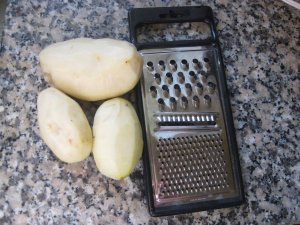
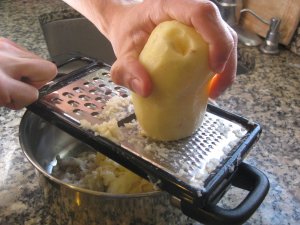
Start by peeling and shredding potatoes (zemiaky).
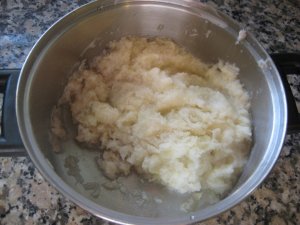
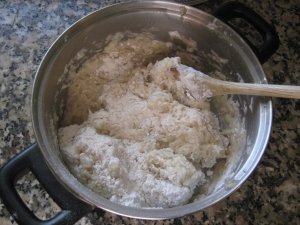
Drain the liquid and stir in about the amount of potatoes in flour.
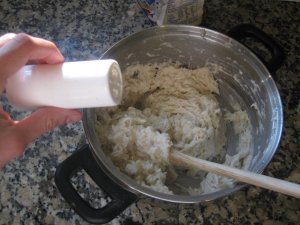
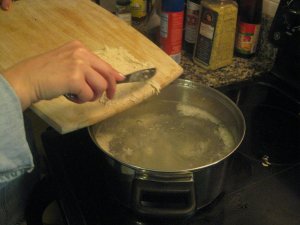
Add salt. Then use a kitchen knife and a cutting board to toss pieces about an inch long into a large pot of salted, boiling water.
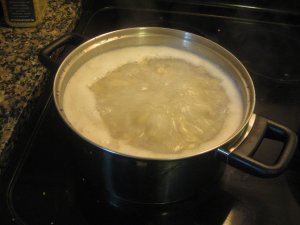
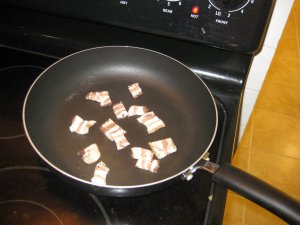
Let cook for few minutes. In the mean time, cut bacon into small squares and fry them to make “škvarky”.
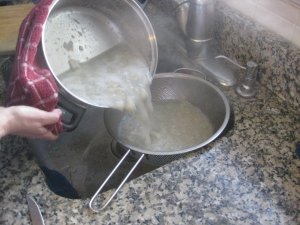
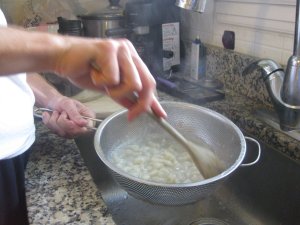
Strain the dumplings. Use a wooden spoon to clear off the goo that clogs up the holes.
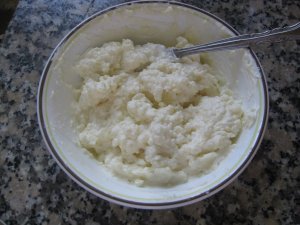
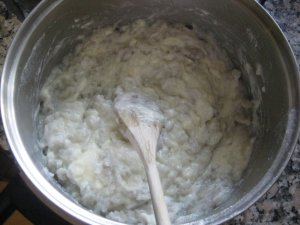
Take your bryndza and stir it in.
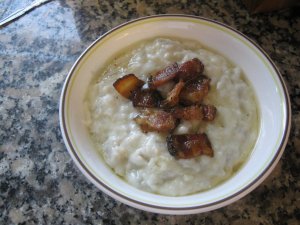
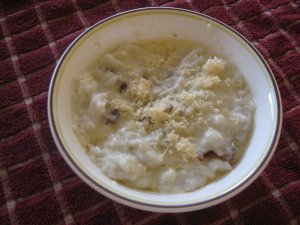
Top with bacon and few spoonfuls of grease. They also taste great topped with with shredded “oštiepok” cheese.
Hi Lubos,
You should try to put at least one tsp of baking soda(our soda bicarbona)into potatoes mix. This food is very heavy and soda helps your stomach to digest this food much better. It doesn’t change taste of it.
Thanks for the tip! I’ll try that next time I make halusky.
Baking soda will actually produce the contrary effect: it is alkaline, so it neutralizes your stomach acids (of course only in the measure of the amount you use and the strength of the alkali).
This does not mean that using baking soda in your halusky will not make it “feel” lighter. So go ahead and use it at wish.
If you eat too much of anything, it will be heavy in your stomach. Nedajte velka masti ani slaninky, aj bryndza je tazka do zaludka. Jedzte menej. Dobru chut!
Halusky seems to be the same as Hungarian strapachka. Are you familiar with that dish?
—John Koethen
I heard of that dish, but I am not quite sure what’s in it. Let me look into this. But… the word strapachka (actually strapačka) is of Slovak origin. It would loosely mean something that’s really disheveled or shaggy. If a guy is “strapatý”, then his hair is messy. Thanks for the note!
Strapachka is how we Hungarians call Slovak Bryndzove Halusky :)The name derived from Slovaks around Bekescsaba (Hungary).
They are called ‘strapacky’ because by adding graded potatoes, they do not have smooth texture, thus are ‘strapate’- disheveled. Delicious nevertheless. I just found Slovak sheep cheese ‘bryndza’ and will make them soon. Dobru chut – Bone Appetite.
My grandmother and great aunt used to make a similar dish they called “Trepankes” (close enough to the word “strapachka”). They were from Slovakia, about an hour out of Kocise, so a lot of their recipes used mixed slovak/hungarian names.
I’m making a version of this for dinner today. My grandma’s recipe uses sour cream & cottage cheese instead of the bryndza and shred a small onion with the potatos.
try to use feta cheese( the original from sheep milk), you need to put it in food mixer or mash it with fork first. you can add bit of soured cream or milk- and it works.
Diky za tento recept…pri pohlade na “finalny vyrobok” sa mi v ustach zdvihla vlna prijemnej vlahy a uz sa tesim na vikend a varenie halusiek. Bryndzu sice nemam, ale feta zmiesana s curd je aspon trocha prijatelna nahrada. Ale taka majova bryndza by bodla…nuz co, musime sa uskromnit… 🙂
I thought these pictures were not the greatest, so I posted another recipe for halusky. That one shows you how to make just halusky, without any toppings. Halusky are very versatile. You can serve them with stews like chicken paprikash, or top them with bryndza, cabbage, or egg, and get a meal on its own.
Does anyone know how much salt to add?
I don’t measure the salt precisely, but I add about 3 or 4 salt shaker “shakes” to the water in which I boil the dumplings. I also add about two “shakes” into the dough. I hope this helps!
I’m Hungarian and I live in Hungary. The Hungarian sztrapacska is the same as bryndzove halusky. We use a very similar cheese for this dish, called “juhtúró” in Hungarian, but Slovakian bryndza is also available (mostly in larger supermarkets)in Hungary.
Lubos, if you want check: http://bryndzovehalusky.druskova.sk/sk/recepty-halusky
“Strapačky” are known in my family as potato dumplings with stewed sauerkraut (sour cabbage?).
Does your Granma know how to make “tarhoňa”?
Your website has to be the etlecronic Swiss army knife for this topic.
For bryndzove halusky I have found success with mixing feta with Philadelphia cream cheese (the lighter one- not fat free) and a little milk.
thanks for tip… will try that as it is hard and too expensive to get bryndza in uk
My Grandmother was from Kocise and has passed on her recipie for halusky. It consists of the potato dumplings mixed with drained sauerkraut and fried bacon and onions. Ohhhh sooo very goood!!!
Hi Cathy, can you share that recipe? Thanks
Hi,Could you send me that recipe, Thanks, Gene
Strapačky
http://www.svetvomne.sk/recept/666/Strapacky-s-kyslou-kapustou-recept
Another version is the dumplings with browned butter and cottage cheese. Another yummy version. I suppose when my Novak family moved here in the mid 1920’s that is what they had here instead of the bryndza cheese.
je suis de montreal en 2007 j’ai visite slovakia et j’ai mange bryndza halusky pour la premiere foi et j’ai aimer sa mais ici nous n’avon pas de bryndza domage il faut que je visite la slovakie pour achete bryndza
Tu dois visiter Toronto pour acheter bryndza! C’est disponible ici!
great, congrat Lubos, you worked on it and you should be recognized!
cheers 🙂
oops, I thought I was replying to a World Cup food, post, talking and about each country favorite food and linking halusky to this site.
Nevertheless, I say it again, well done Lubos! 🙂
I saw you mention a soup in a related post. My grandmother used to make “brown soup”. A roux of burnt butter and flour (fried onions?) to which haluski and diced potatoes were added. Vinegar was poured into individual bowls to taste. This was my favorite food of all time-appreciate your time…
That particular soup doesn’t ring any bells, but it definitely sounds like it could be Slovak. We have so many different kinds of soups in Slovakia, and many of them consist of roux (zápražka), which is made from butter and flour, and sometimes also grated onions. This is then combined with basically whatever you have at hand: potatoes, mushrooms, etc… And halusky are added commonly to soups, especially chicken “noodle” soup. For instance, see: http://www.slovakcooking.com/2010/recipes/potato-soup-zemiakova-polievka/
I think this is polish food. they do it with stale bread.
Hello!
I live around the corner from Slovak-Czech varieties and was able to grab some bryndza in order to make some bryndzové halušky. On the package, it notes that it should be combined 1:1 with cream cheese.
When you mixed the bryndza with sour cream, did you do it separately and then add it to the halušky? Any suggestions for combining the cream cheese and bryndza as smoothly/easily as possible? And do you think this ratio is about right, or is there a better combination?
Thanks for all of your help and for this amazing resource!
Hey Adam, bryndza should not be combined with sour cream. My best guess why their package says that is that their bryndza is of export variety, and has been dehydrated somewhat so it keeps better. The sour cream is thus used to make it more creamy, and thus easier to mix with the halusky. The sour cream would also make the taste more mild. I would say, try adding the bryndza on its own. If it doesn’t melt sufficiently, or if the taste is too strong, then combine it first with sour cream and add it like that.
Not sure if you have seen my note about the Trader Joe’s “imitation bryndza“, but when I buy that I don’t mix it with anything.
The best tasting feta cheese, most similar to bryndza is imported Bulgarian feta sold in many US supermarkets. I do not mix it with anything. By letting it stand at room temperature in serving dish, the feta gets softer and creamier. Then I press it with fork and put hot halusky over feta and mix it. Unsliced bacon, cut in cubes and then fried makes a great topping.
Maria, where do you buy unsliced bacon? I’ve been looking for it, unsuccessfully, for months.
I suppose all central European specialty stores, deli with imports and specialty meat markets are worth to check.
I buy it at Polish or Russian deli, where I ask to give me about a pound of smoked bacon in one piece.
im eating this right now hehe delicious
only my boyfriends mom taught me to mix sour cream and feta from the european market since its hard to get bryndza cheese. i also added some fresh dill to it 🙂
i would like to share a bit of my story as well… i’m from slovakia, working and living in UK for couple of years now… and i use to absolutely hate bryndzove halusky the way my family prepare them… i did tried to eat them couple of times, but i couldn’t eat them at all… I hated the taste of them and anytime somebody tried to force me to eat them my skin goose bumps straight away… I think my family recipe is the same as your’s lubos and i know it sounds strange that the original Slovakian hated the original slovakian dish… well i hated them only until i started working in traditional slovakian restaurant = Salas (shepherds cottage) couple years back when i was student back home in slovakia … one day it was so busy there, that i was forced to eat the quickest dish they could prepare for staff… bryndzove halusky… well i give it a go, ‘cos i was soooooo hungry and i couldn’t believe the taste i got from them, they were absolutely amazing i couldn’t stop eating them, right now they are my favourite dish and I’m making them on regular basis for all my slovakian friends here in uk as well… now what was the catch that they taste different from my mum’s ones… i can guarantee you it was not the hunger which make them taste so good :)… i asked and watched chefs in this restaurant preparing them in the kitchen and all what they did was that they put already cooked and strained halusky back to the cooking pot add bryndza, milk and let them cook on low heat, stirring occasionally (be careful as it can easily burn, ‘cos the bryndza stick to the bottom of your pot)… cook it until milk is reduce and bryndza wrap around your halusky and became very cheese, same as when you melt the cheese (is hard for me to prescribe it right now, but is like melted cheese on pizza when you tearing pieces apart, when you see your bryndza/cheese starting doing similar thing in your pot it is ready to be serve)… small tips… you can add the whole bryndza straight to the pot, pour in milk as the bryndza will dissolve itself by the heat in the milk, you don’t have to mix it separately before you add them into the pot… also another thing is that halusky going to look in your pot a bit watery from beginning (soup-ish like), but don’t worry by the cooking and reducing the milk in pot bryndza will thicken it up eventually… they use to serve different varieties of bryndzove halusky in this restaurant just by adding different things on them before serving… the one i love is bryndzove halusky with pan-fried bacon, pan-fried traditional spicy sausage (domaca klobasa) and finely grated cheese (can be ostiepok, even cheddar will do) on top… to me they taste different and more delicious when they are re-heated and cooked in bryndza than when bryndza is just poured over halusky… i met many people from many different parts of Slovakia, but they always just poured bryndza over halusky… maybe that’s why they taste different in some of the traditional slovakian restaurants from the ones you make home… well at the end it help me eventually to fall in love with our traditional dish and i won’t eat them now any other way than cooked in bryndza… so if you know some stranger like I was, which is hating or not enjoying our national dish try to cook bryndzove halusky for them this way to see if you don’t make them fall in love with this dish as it happens to me… or just try to cook the restaurant standard halusky for yourself to compare which one’s taste nicer… I already have my winner and even of that i don’t really have a good memories from the time i was working in that restaurant i’m thankful that i worked there as it make me crazy in love with bryndzove halusky 😉 🙂
Kathy, what restaurant was this? I would love to try them like that. But as far as the bryndza goes, you are right, it’s the best to get it melted. What I do is I mix it in right after I take the halusky out and while they are still hot. Melted bryndza has a much better taste than when it’s “fresh”. It’s more creamy, like cream cheese.
The restaurant is near by Bojnice Chateau/Castle and the name is Salas Viglas. Haven’t been there for about 10 years now, not sure if they keep up the same way, but that’s how they use to do them when i was working there. normally they prepared a massive amount of halusky a they use to keep them in fridge as it is hard to predict in restaurants how much to do and it wouldn’t be possible to keep up making fresh ones to order… and ‘cos they need to reheat this halusky, I think that’s why they use to do it this way… i wasn’t sure how you do it ‘cos on your pics they look quite similar to my one’s, but i didn’t see anywhere comment about cooking them in bryndza, i think you right… hot halusky can do the same trick as when you cook them in bryndza… i absolutely agree with you that melted bryndza taste much more better with halusky
😛
I make bryndzove halusky with greek sheep feta from italian store and unsliced bacon from german store. I am slovak and my boyfriend is canadian and he absolutely loves this food.
If you can buy fresh sheep cottage (no pasterizing), you can make bryndza at home. Like (in slovak language) http://liptov.sme.sk/c/4884958/bryndzu-nekupuju-robia-si-ju-doma-sami.html or http://www.mimibazar.sk/recept.php?id=13590
Awesome, thank you Mick. You rule! Although finding unpasteurized cheese in the US won’t be easy – it’s illegal to sell it. http://cheese.about.com/od/cheesebuyingguide/a/raw_cheese.htm
Hi Lubos! Greetings again from Indiana.
In the great Christian tradition in the Church it is now the Lenten Season. We abstain from meat on every Friday during lent. How about putting a pitch out on hear your Web site for some fans to send in NEW meatless meal recipes.
Look forwarding Looking forward to Easter and from your reply.
Philka
really the next best thing to bryndza is real feta cheese.
I lived in slovakia for several years. Halusky refers to the potato dumpling noodle that is pushed through a sieve like pan into boiling water.
Bryndzova halusky is made with the bryndza cheese ( a slightly sharp, slightly drier, sheeps cheese) with sour cream, butter,and diced chopped bacon. Feta isn’t a bad outside option.
Recipes vary but you get the idea.
Strapacky is when the halusky are cooked with sauteed sauerkraut, onions, and bacon. Again there are variations but that’s the gist of it. Good hearty winter food.
I live in US and use Bulgarian sheep cheese. It is much better than Greek feta. Sour cream is always good, I will try it. I never thought of dill, use that for gravlox, but why not. Sometimes I use small pieces of bacon in dumplings themselves, also chopped chives from garden.
On another note does anybody make radishes with scallions and chicken fat? One of my favorite dishes.
Me again. You can also use bone marrow in dumplings. Gives it a slightly different taste, but mnam.
Lepší preklad pre halušky je z češtiny. Halušky sú po česky noky, v preklade gnocchi. Dumplings sú knedle rovnako v slovenčine aj v češtine.
My grandmother was from what is now Henclova, Slovakia. She would boil 1/3 of the potatoes and grate the rest. She added flour and salt to the grated potatoes. She didn’t drain the liquid from the grated potatoes. The dumpling like mix was scooped from a bowl with a spoon in small bits to the boiling water. I add a little oil to the water to keep from sticking to the bottom. After the last was scooped in it is boiled for 6 minutes and drained. Then she would add mashed boiled potatoes, fried chopped green onion and diced bacon, the bacon grease with melted butter and half and half. It has always been a family favorite. Different family members would add their own extras like cottage cheese or sauerkraut.
Needless to say we don’t eat this often as our lives are more sedentary than our grandparents. They lived on a farm without electric appliances.
In 1997 I visited Henclova and saw the house my grandparents lived in before coming to America. Outside of a major shopping area in Bratislava I saw two men demonstrating the making of halusky. I sure never thought I would see that in my life.
Jednotlivé recepty sa od seba líšia podľa toho, akú múku použijú alebo či dajú vajce. Vajce má funkciu pojiva.
http://www.akosatorobi.sk/video/323/bryndzove-halusky-recept-na-halusky-s-bryndzou
Joan, ja pochádzam zo Západného Slovenska a tu nie je tradícia miešať cestovinu s varenými zemiakmi. Halušky so zemiakmi je nejaký regionálny recept. Všeobecne známy na celom Slovensku je “granatiersky pochod”, to je cestovina nazývaná fliačky zmiešaná s varenými zemiakmi plus upražená cibuľa s červenou paprikou.
yes. I don’t cook it (granatiersky pochod), for me it’s too much carbs in a meal, but my sister makes it back in Bratislava. It needs some good light side salat, cucumbers, etc.
Thanks so much for this recipe and the others on the site. I love the photos – very helpful – and the expertise. I lived in Slovakia in Modra and then Spisska Stara Ves for a while and loved the traditional foods as much as I loved the Slovak people. I have been craving Bryndzové halušky for a while now! Thanks for helping me make them here in the US.
I appreciate the effort made here, and I find the explanation of the method useful, but I find the complete lack of quantity measurements frustrating. I found a good recipe on wikibooks (https://secure.wikimedia.org/wikibooks/en/wiki/Cookbook:Bryndzov%C3%A9_halu%C5%A1ky) that actually uses bryndza (many recipes I’ve seen substitute some other cheese).
I live near Toronto,Canada and Bryndza is available at an Eastern European store “Starsky”. When I was growing up and my mother would make Halusky, she would use dry cottage cheese in them. She would make 2 kinds of halusky for dinner. One with the cheese, brown butter and bacon and the other with fried sauerkraut and brown butter and bacon. No plates on the table only a fork in hand and two large bowls on the table. Dig in. WOW delicious. We never could decide which combination was best. I make it now for myself, but only about once a year to bring back my own memories. Very heavy, but very very good.
My mother also made halusky without potatoes, flour,baking powder, egg, water,and a little
salt. Wonderful with the chicken drippings from baked chicken. MMMMMMMMMMMMMMMMMMgood.
I am so grateful for your article post.Much thanks again. Awesome.
My Great Grandma who came to the US from Czechoslovakia in the 1910’s made Halusky for us but she used Wisconsin Brick Cheese instead of feta – much creamier! We still make it for our families and there’s nothing better (to me) than left-overs!
Thanks for the helpful instructions and great step-by-step photos. Now I am ready to relive my memories of having Bryndzove halusky all over northern Slovakia!
Hi everyone,
I was wandering if anyone knows where to buy brynza in South Africa (Johannesburg preferably) 🙂
My wife (whose grandmother emigrated to Montana from Žakarovce in the early 20th Century) learned to make halušky in a very similar way. There were a few differences, but not many. The main difference is that they would use potatoes that had been boiled and mashed, then mixed with egg and flour. She then rolls the dough out on a board, cuts it, and drops it into the boiling water. Bryndza cheese is not available, and she doesn’t like feta, so we use cottage cheese as a substitute. One day, I would like to make fresh farmer’s cheese and try that!
Anyway, when the halušky floats to the top, she then drops them into a cast iron pan that has bacon and onions frying in it. Sometimes the pan also has cabbage. Evidently, she says that halušky is either with cabbage or with cheese (in our case, cottage cheese), but never both! The funny aprt is that we usually use both anyway, stirring in the cottage cheese right at the end so that it just starts to melt into the halušky, bacon, onions and cabbage. The ebst aprts are the parts that brown and “almost burn” a little.
If anyone is interested in seeing this way of making halušky, you can see it here:
http://foodsoftheworld.activeboards.net/haluky-s-kapusta-alebo-tvarohom-starej-mamy_topic1253.html
Please forgive me if my translation of the title is wrong!
huge appreciation goes out to Lubos for his efforts with this site. Thanks to him, my wife is trying new dishes from her ancestral land, and I am learning more and more about good, real food that always states great!
Woah, a few typos up there ~ apologies!
omg you guys suck at cooking. we chiniese cook so nice -_- hiii yaaaa
I am of Slovak heritage (both sets of grandparents came to the US from Slovakia), my grandmother on my mother’s side immigrated to the US from Stara Tura, and she only made her halusky with flour, eggs, salt and water. I never knew about using potatoes for the batter until I began going to Slovakia in 2002 to teach conversational English to children in Lucenec. This recipe is great, but do you cook the shredded potatoes first before adding the flour?
no, don’t cook potatoes, just mix row shred potatoes with flour.
I just made me halusky last night using original brynza I brought back from my recent trip.
Oh my, it was good! MY SO was gone for her PhD assignment and as she is not a fan of halusky, I made it while she was gone and ate it all (I think it was a serving for 4 people)
🙂
My grandmother made this recipe but used Swiss cheese. I can’t find any recipe that used Swiss cheese on the web, my family loved this dish. She was born in Austria. Has anyone else ever heard of using the Swiss cheese. It was really good.
Went to Smrdaky in 1985 with my mom to visit her family. She took me to a restaurant by a lake that served Bryndzove Halushky. I fell in love with the dish and have been looking for a recipe ever since. It was my father’s (from Rajac) favorite dish. Thank you for posting this marvelous food.
Great information from all of you. I was just in Bratislava and my cousin made Halushky with the special cheese I think and bacon. Love the noodles so have been looking for a pan with appropriate size holes as she took the dough and pressed it through the holes I think?? I want to try them and all this information from everyone is great. Thanks!
My mother is second generation Slovak-American, and when I was a kid she’d often make egg noodles with cottage cheese. I thought that was just one of her quirks, but it’s probably a very Americanized descendant of this dish, right?
Great site you have here but I was curious about if you knew of any user discussion forums that cover the same topics discussed here? I’d really like to be a part of group where I can get feedback from other experienced people that share the same interest. If you have any suggestions, please let me know. Many thanks!
I am from Slovakia. Just found company on Internet, which carry many European ‘stuff’ among them Bryndza, Slovak sheep cheese, used in Bryndzove halusky.
As far as the special pan goes,
you would have to go on internet to find that special pan with holes, to press your dough into boiling water. It is round with handle and small holes (about 1cm in diameter) on the bottom. But before this pan was available in Slovakia, my Mom put this soft dough on small wooden board and with help of knife with great speed pushed halusky, one by one, into boiling water. I was never able to get that speed, but by that time, special pan was in stores.
The company I mentioned above is: Fabko, https://fabko.com/contact
Maybe they will be able to help you find this special pan. Good luck.
This was replay to Carol James
Oh my goodness! Impressive article dude! Thank you so much,
However I am experiencing difficulties with your RSS.
I don’t understand the reason why I am unable to subscribe to it.
Is there anybody having the same RSS problems? Anyone that knows the
solution can you kindly respond? Thanks!!
Um, Charlie – if the was a “democracy” you wouldn’t have a job because a
democracy doesn’t have a Congress https://lawyersofficedallastx.com/
I don’t know whether it’s just me or if everyone else encountering issues with your site.
It looks like some of the text on your content are running off the screen. Can somebody
else please provide feedback and let me
know if this is happening to them as well? This
could be a issue with my browser because I’ve had this happen previously.
Many thanks
All of those areas of photography require a solid background in the basics.
The Cypress Grove Estate Wedding Photography is the correct choice for individuals arranging destination weddings.
We, the marriage photographers, have argued amongst ourselves for years
as to which camera system is finest. Remember… lengthy
after the dessert has been consumed and the wedding dress is compelled to the
back of the attic space, you’ll nonetheless be searching at your
wedding pictures and remembering the joy of your particular day.
Still relatively cheap, these cameras may be an excellent introduction to digital and
are excellent for the households of severe photographers.
Violating copyrights can result in stiff fines,
and it may spoil your organization’s relationship along with your company photographer.
I keep chook baths and chook feeders close to the home so I can watch and take footage
of the birds. Though digital photography hasnt modified
a lot about the way in which we take photos (point and shoot), it has
had an immeasurable impact on our capacity to share our pictures
with the world. Most of us at one point in our photographic historical
past realized that capturing photographs in dim gentle, or honest darkness adjustments an otherwise mundane scene into a
much more interesting, and in many circumstances a surreal
scene. https://mondino-update.net
Woh I like your articles, saved to favorites!
The article is very easy to understand, detailed and meticulous! I had a lot of harvest after watching this article from you! I find it interesting, your article gave me a new perspective! I have read many other articles on the same topic, but your article convinced me Kavach
Asking questions are truly good thing if you
are not understanding something completely, except this post gives
pleasant understanding even.
Watch Online Bahu Begum Full Episodes at Colors Tv, Colors Tv Hindi Drama Bahu Begum New and Old Episodes online in high quality HD videos, Hindi Serials.
https://bahubegumtv.net
This is very Amazing and Very Informative Artical we get alot of Informations from this artical we really appreciate your team work keep it up and keep posting such a informative articles..
That is a good tip especially to those new to the blogosphere.
Brief but very precise info… Thanks for sharing this one.
A must read article!
Thanks for posting this recipe. I’d like to try making it in a day or two for my Czech husband. He found bryndza cheese a while ago, and I really need to finally use it. I made a different version of this recipe years ago, but I don’t think it was as good as yours probably is.
Question: How long do you boil the shredded raw potatoes before draining them and adding the flour, etc? All of the other steps are clearer. Keep in mind I’m an American of Anglo background. I only usually boil potatoes in cubes, chunks, or whole.
Do not cook the potatoes, just add the flour to the raw potatoes and salt (personally I add an egg in there too). Also I’ve been experimenting with 1/2 cream of wheat flour and 1/2 All purpose flour. So far the results are promising. Also look on Amazon for a spaetzle maker to add the batter to the boiling water.
I hus i am tanya independent model girl
in saket, Delhi. Please visite my site and call me i am online here.
Thank you for any other informative blog. Where else may I am getting that kind of info written in such a perfect means?
I have a mission that I’m just now working on, and I have been at the glance out for such information.
This is very Amazing and Very Informative Artical we get alot of Informations from this artical we really appreciate your team work keep it up and keep posting such a informative articles…
m confident Bruce Springsteen fans, and Rock fans alike will be pleased with this one.
Come in and see some of his new Grand Canyon works, as well
as some new east coast scenes. All the writing
we’re doing now, however much we currently disdain it, will become wonderful
verbal snapshots later on.
Sofia escorts model agency have guaranteed attractive Sofia escort girls we are open here 24*7 hours.
We are providing services Sofia escorts, Escorts Sofia, Escorts in Sofia,
Escort Sofia, Sofia escort and Call girls Sofia.
Good blog post. I definitely love this site. Continue the good work!
Make them a part of the design after they make sense.
What’s up to all, the contents existing at this website are genuinely amazing for people experience, well, keep up the good work fellows.
“Hi! I love how informative and great your articles are. Can you recommend any other Food Blog Names or blogs that go over the same topics? Thanks a lot!”