Leavened Dough (Kysnuté Cesto)
Ingredients: 1 pack of yeast, 2lbs flour (about 8 cups), two handfuls of sugar, water, baking powder, bit of oil
Prep Time: 30 minutes preparing the dough, at least an hour to let the dough rise.
I spent the day after Christmas visiting with my grandma Therese (starká Terka). She lives in a little cottage in a village some 30 km away from my hometown of Banská Bystrica. I was there just in time to watch her make three of the most typical home-baked sweets: tvarožník, makovník, and orechovník (farmer’s cheese cake, poppy seed roll and a walnut roll). These three baked goodies share the same leavened (fermented) dough. In this post I show you how my grandma prepares the dough. For the recipes for the cakes, see the following posts, or use the links above.
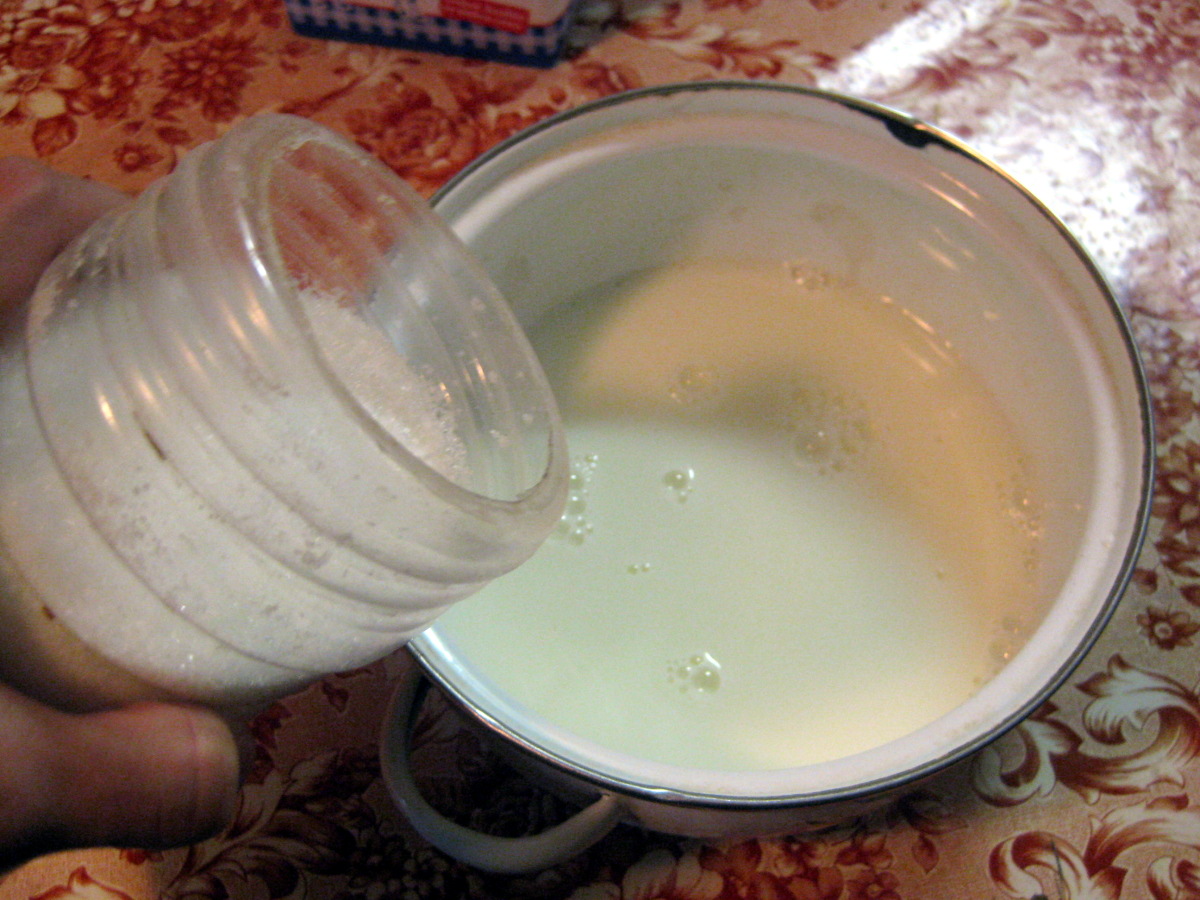
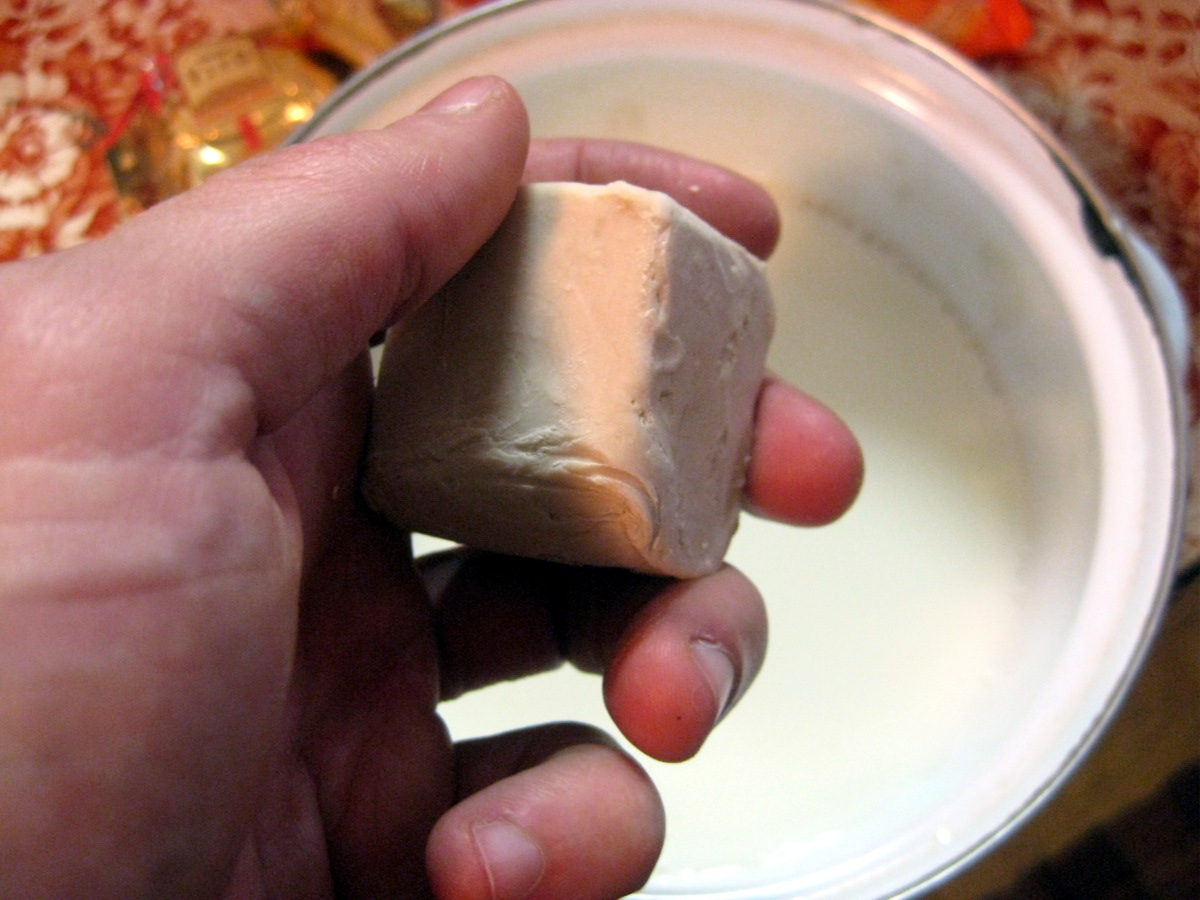
Start by combining about a cup of milk (mlieko), about 4 tablespoons of sugar (cukor) and a pack of yeast (droždie). My grandma used a cube of fresh yeast. In America, I would substitute one packed of the “rapid-rise” dry yeast available in baking section.
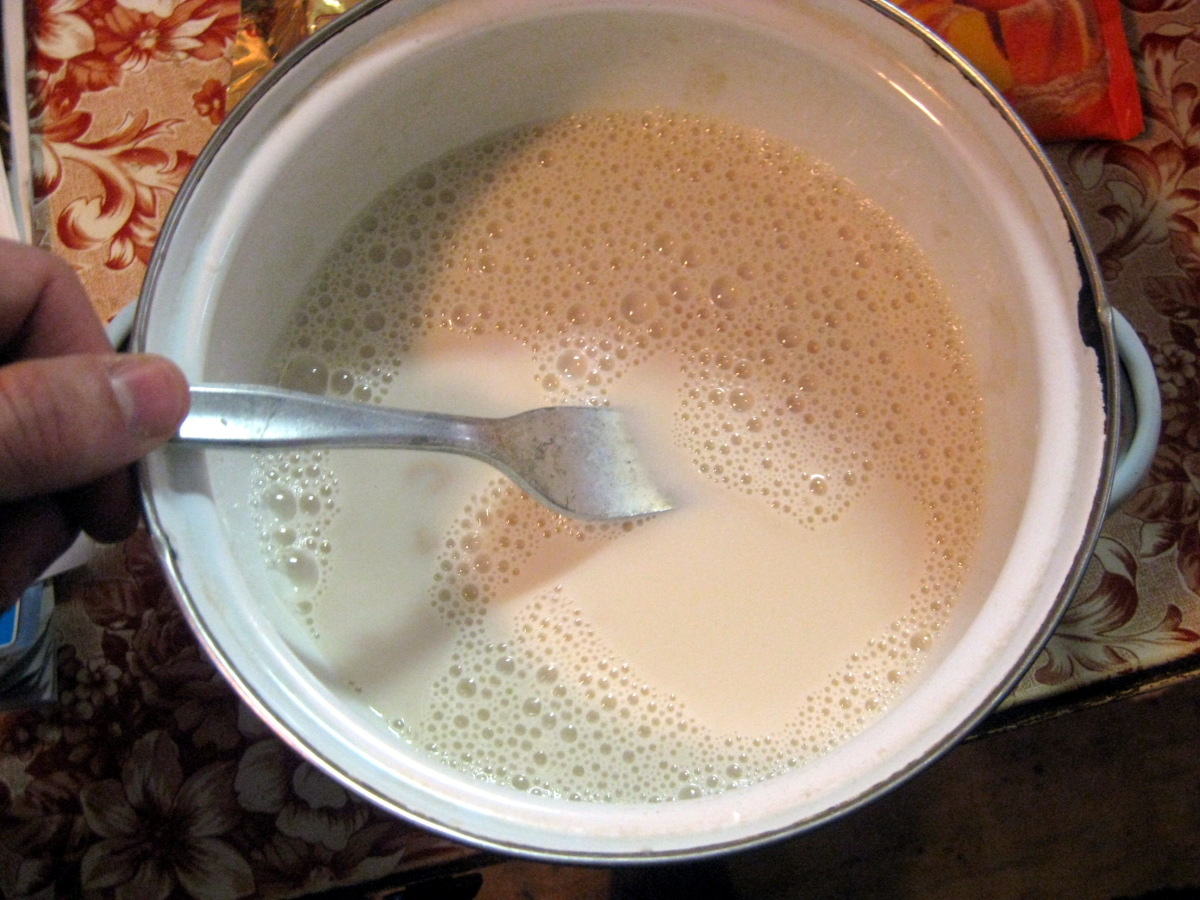
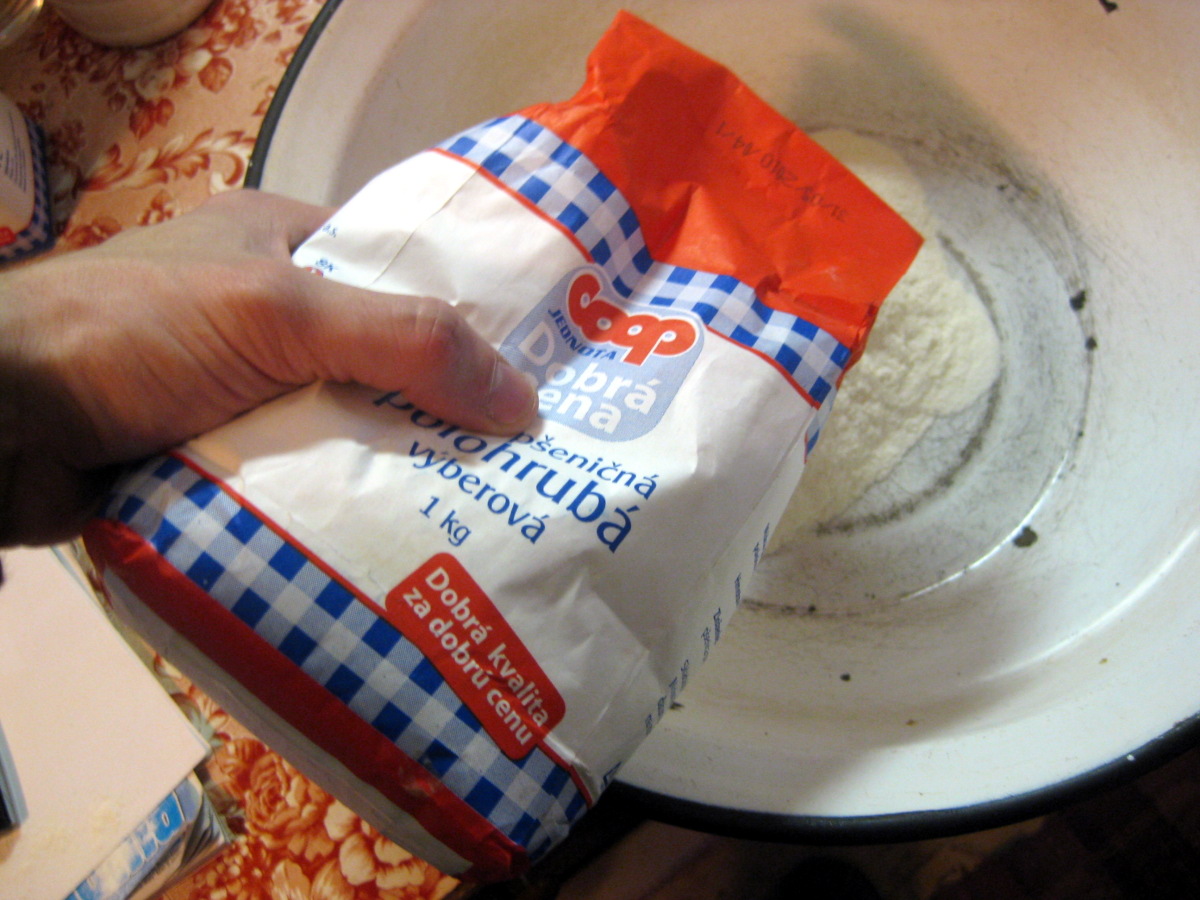
Whisk the yeast well and set it aside covered for few minutes. Whisking is important since it aerates the mixture and makes the yeast more active. For this reason you also need to place the yeast in a warm place. My grandma placed it in her slightly warm oven. At home I just leave the dough on the counter, but start off with a luke-warm milk. To make the dough, pour about 8 cups of flour (múka) into a large pot. We used half of this 2lb bag.
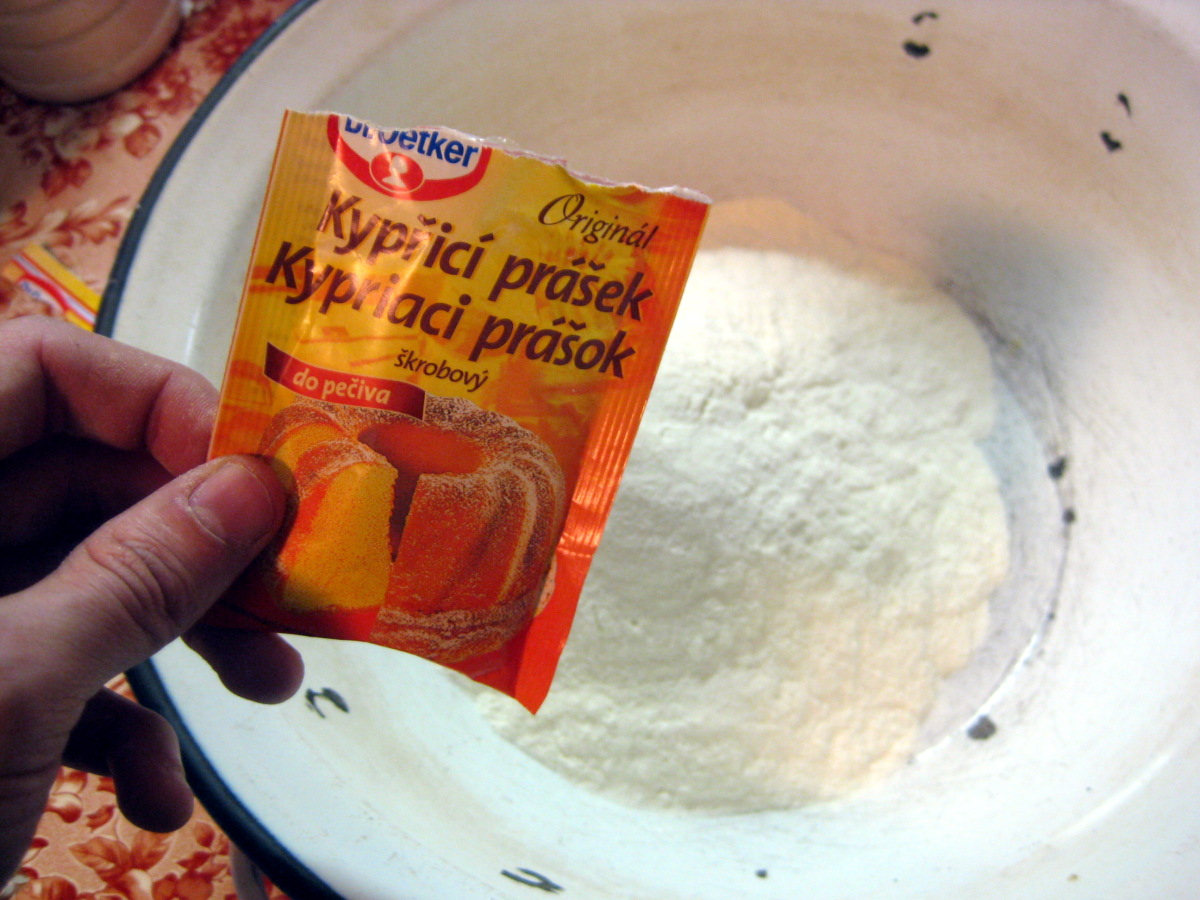
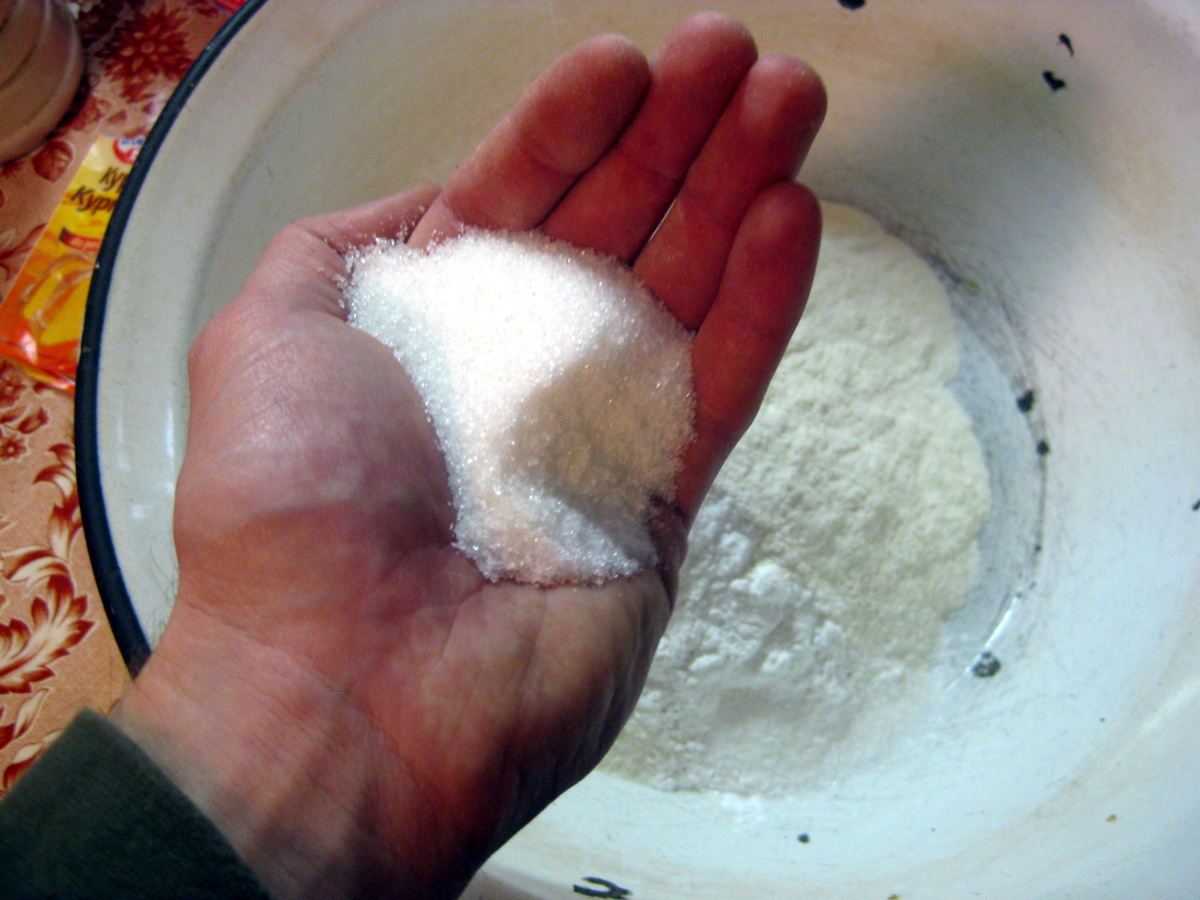
Then add a pocket of baking powder (prášok do pečiva) and about a handful of sugar (cukor). Baking powder is similar to baking soda in that produces bubbles that help the dough rise, but unlike baking soda, it also contains some drying agents. As such, it is less active and makes the dough rise less. Also, it doesn’t not require the addition of an acid to become activated.
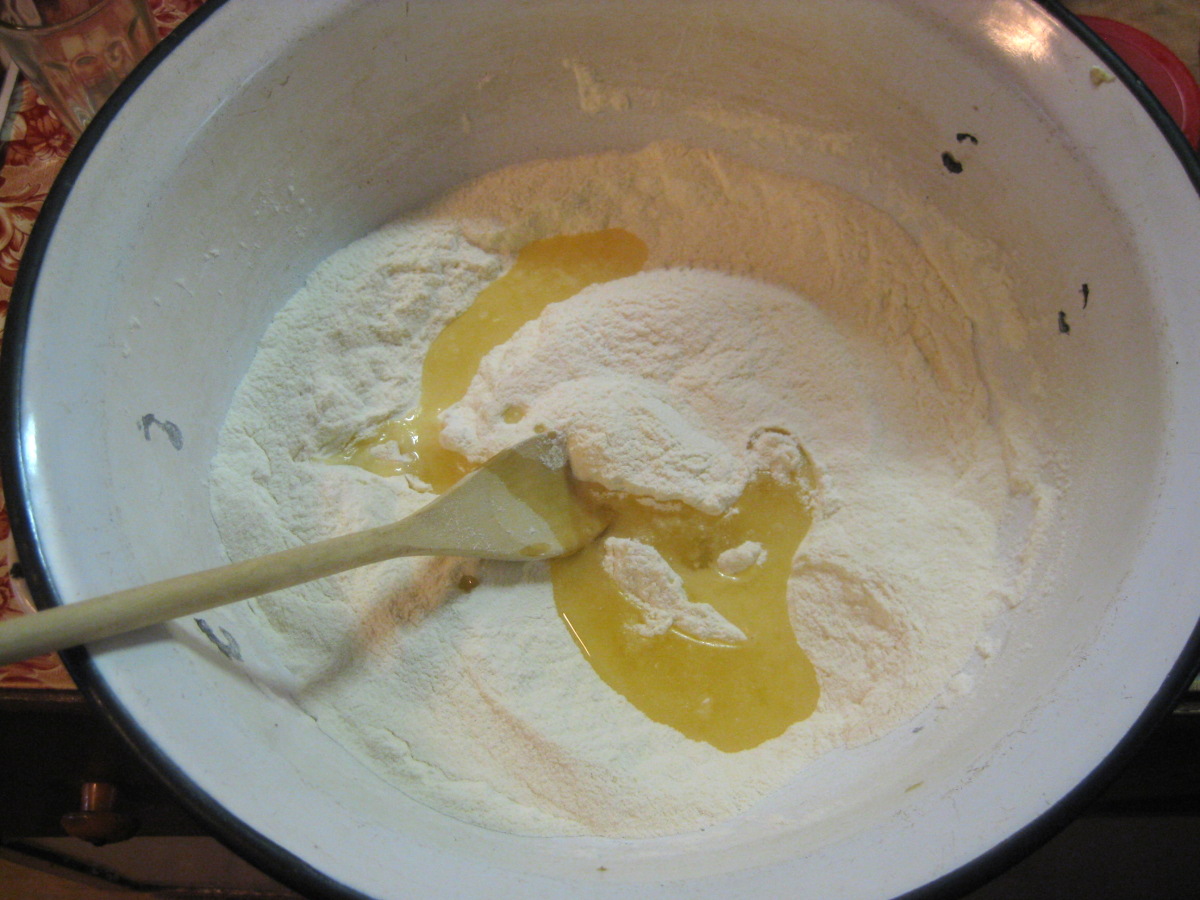

Then add about a shot of oil (olej) and the yeast mixture once it has risen (after about 10-15 minutes). Note: my grandma doesn’t use eggs when making leavened dough. She said that dough becomes tough if an egg is added.
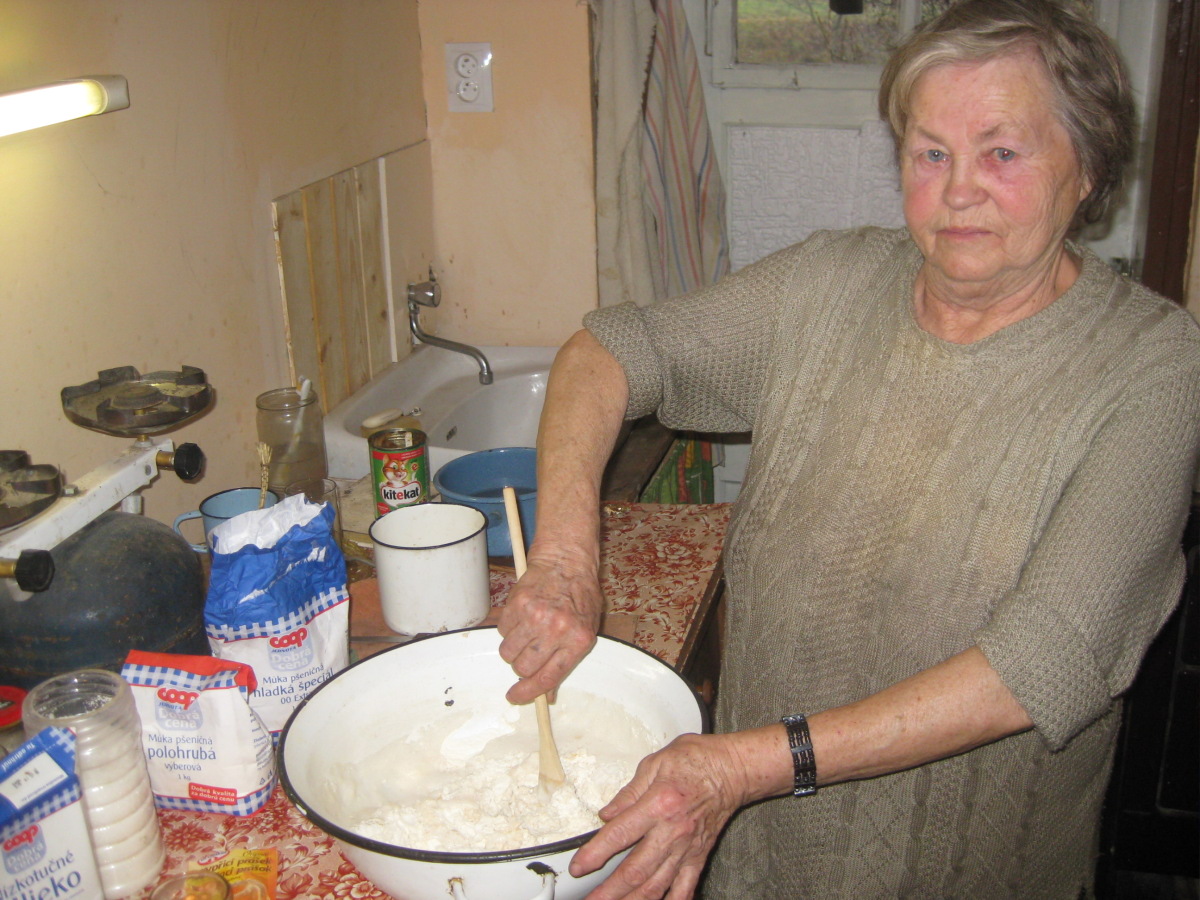
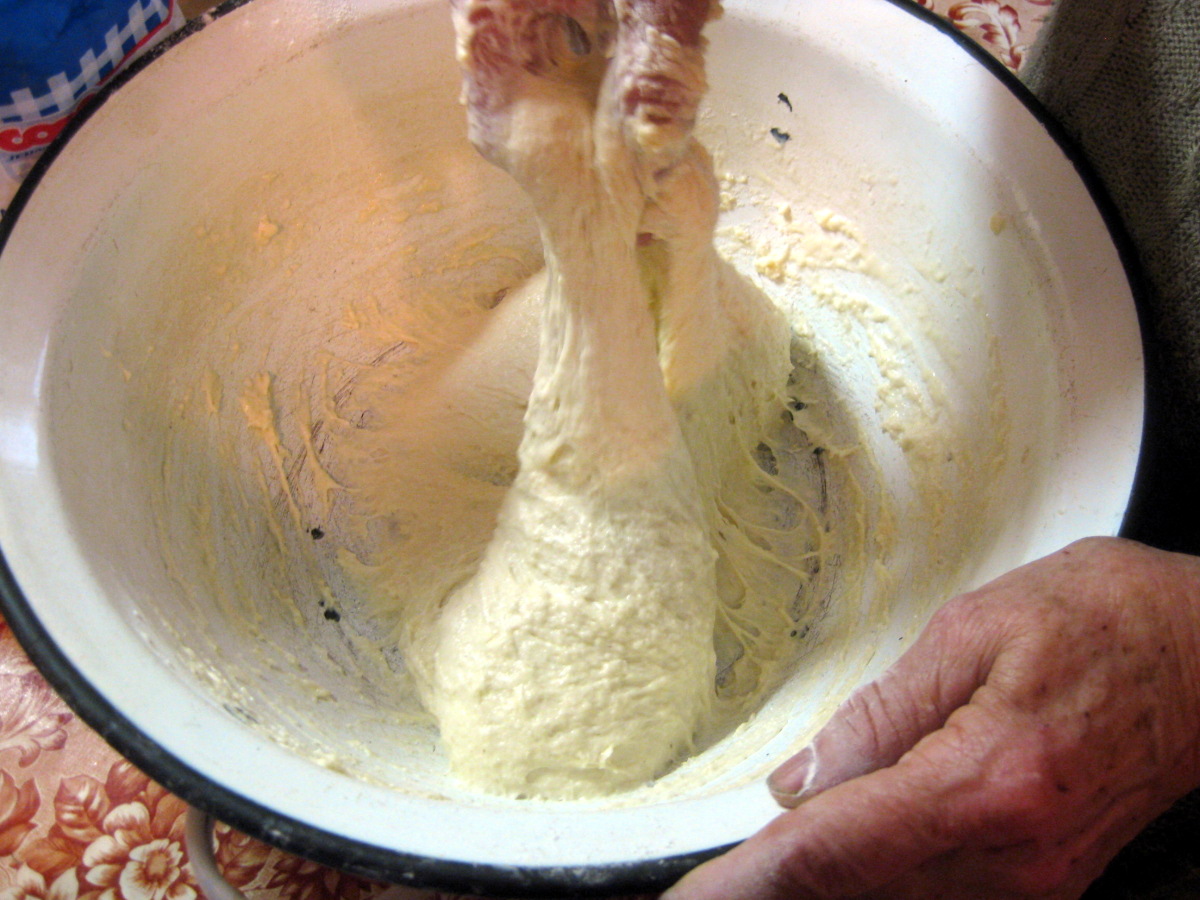
Add bit of water (voda), and work the dough with your hands until it no longer sticks to the pot. Add more water as needed. This is the “art” part of making dough.
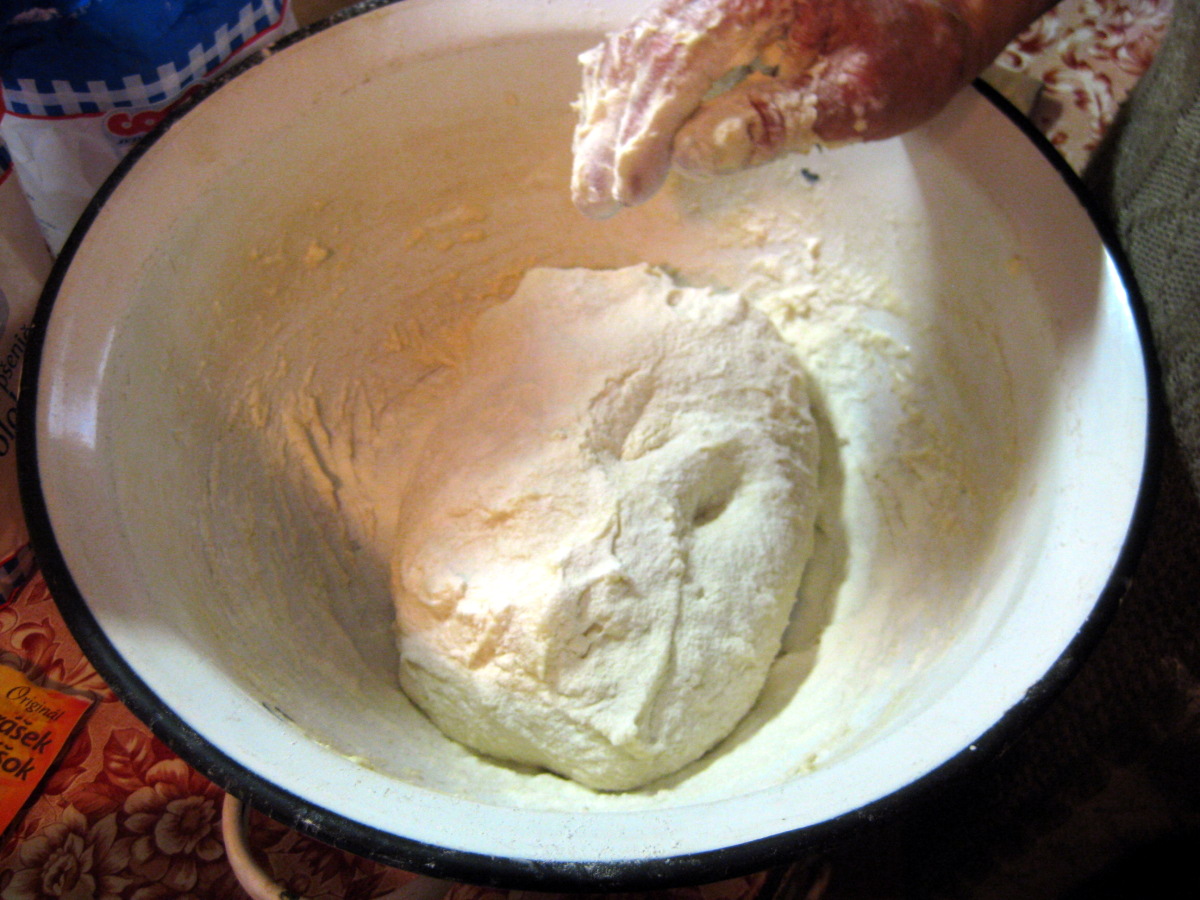
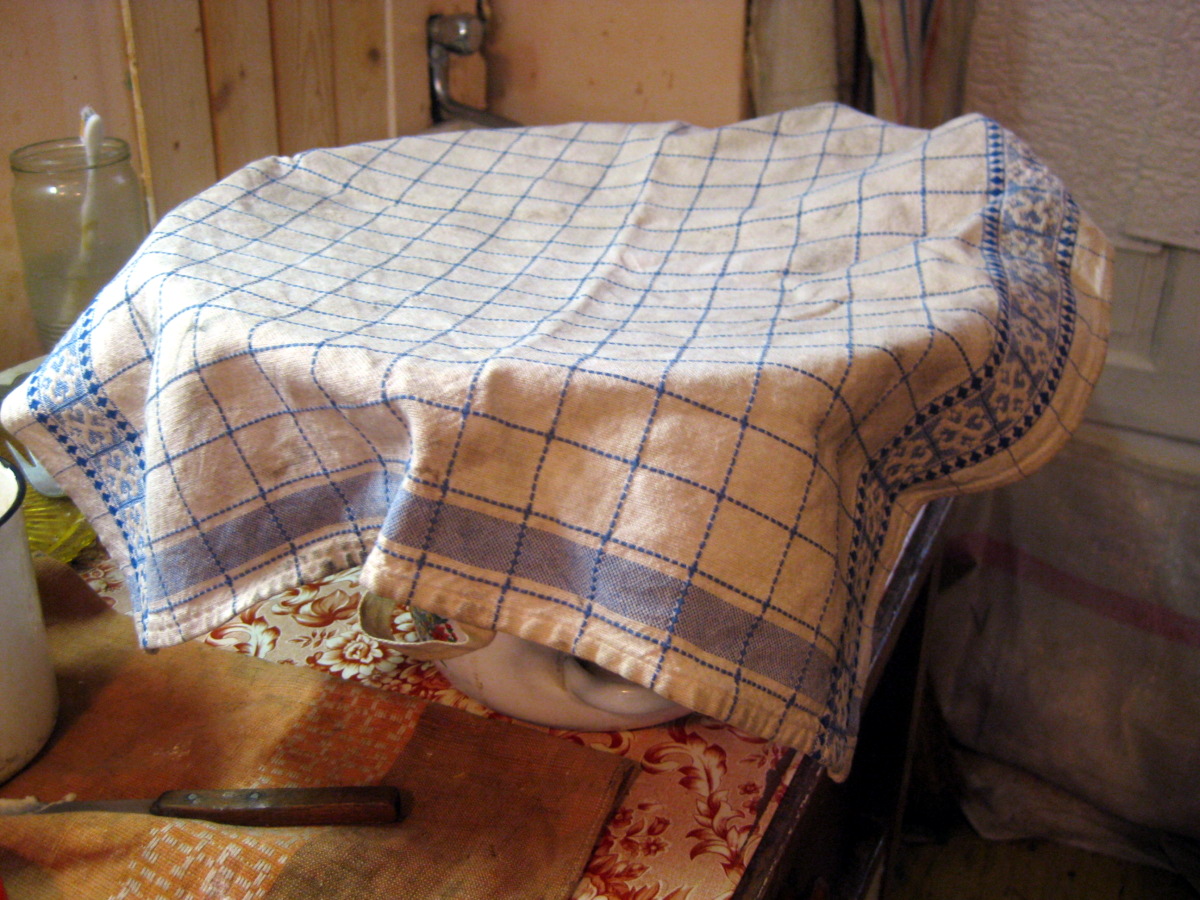
Form the dough into a bun and evenly dust the top with flour. Then cover the pot with a cloth, and set aside to let rise in a warm place for an hour or two.
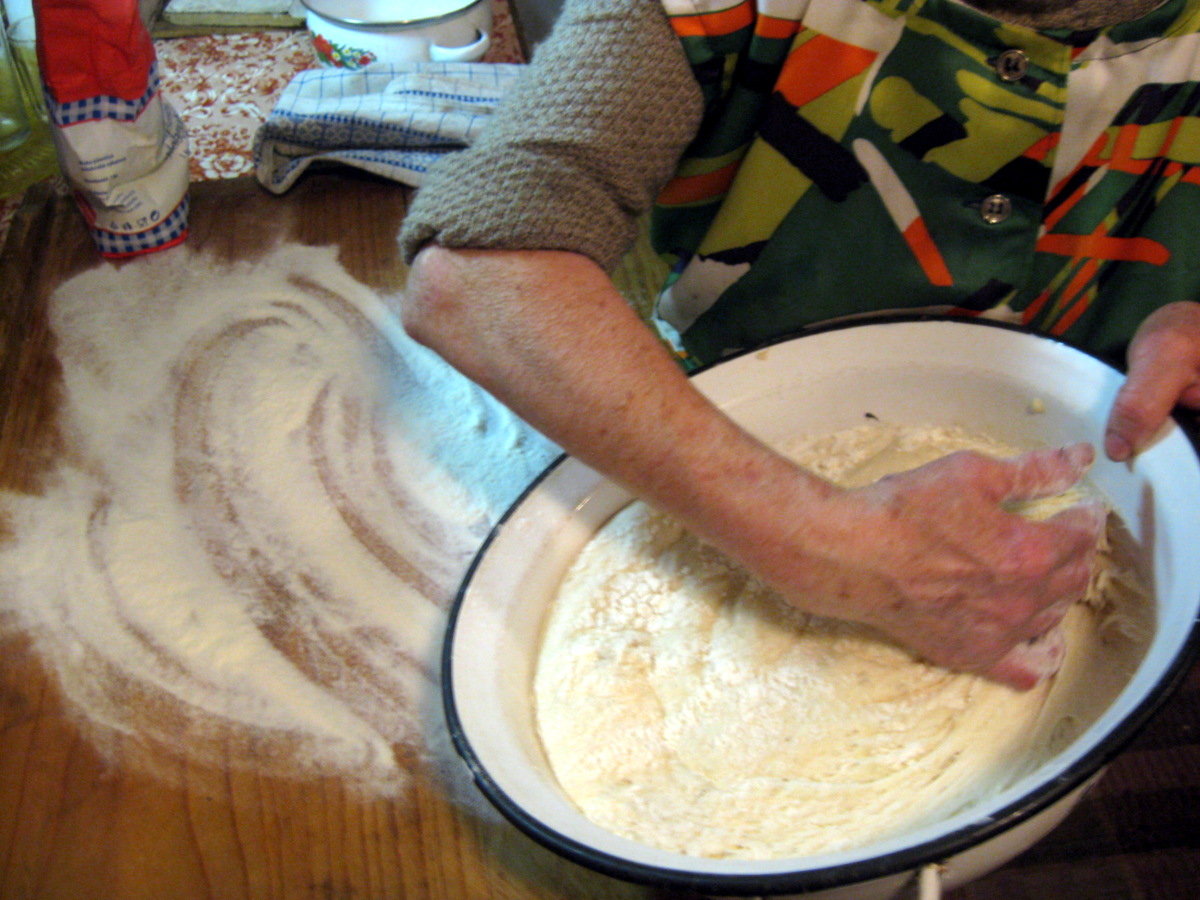
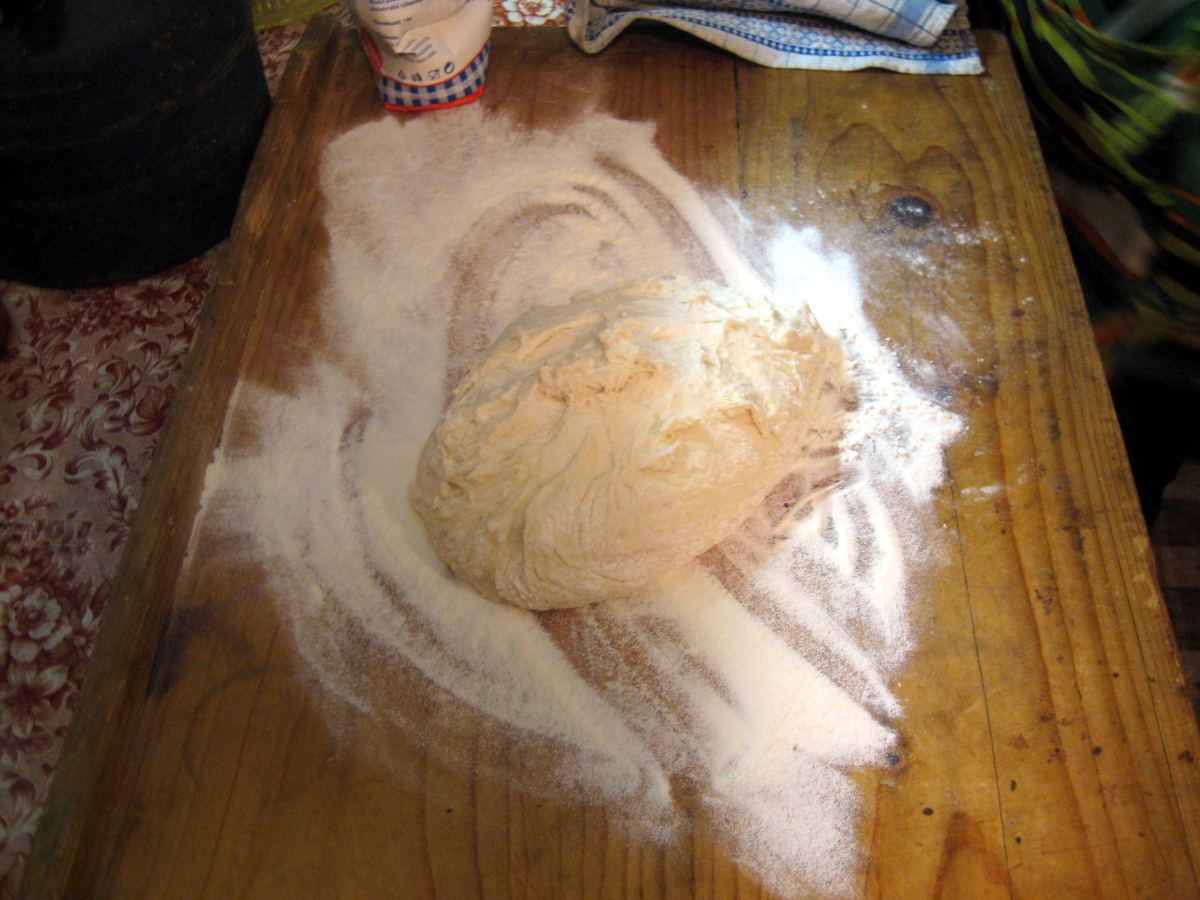
Starká then used this circular motion to scoop the dough out and place it onto a wooden board dusted with flour. Form the dough into a bun.
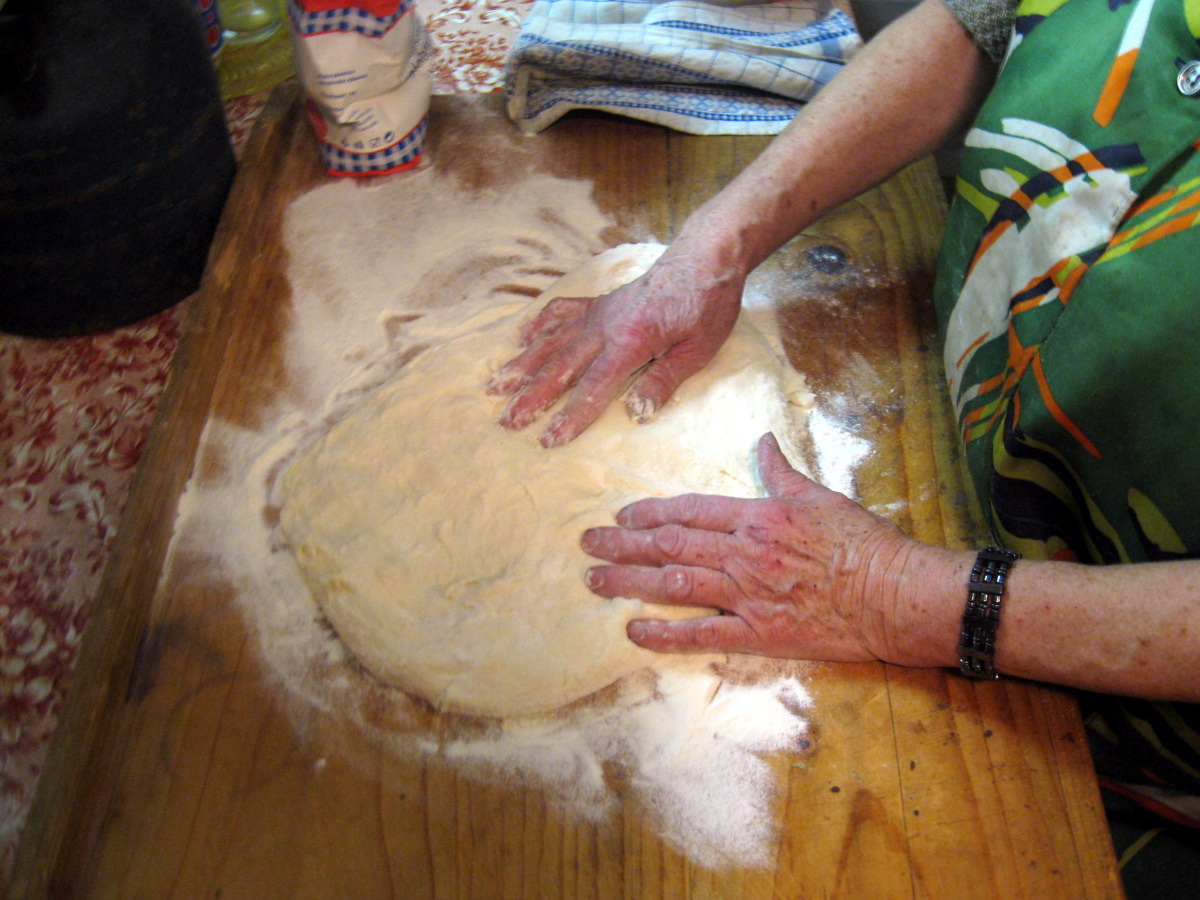

Then use your hands to flatten the dough. Lightly grease it with oil using a baking brush.
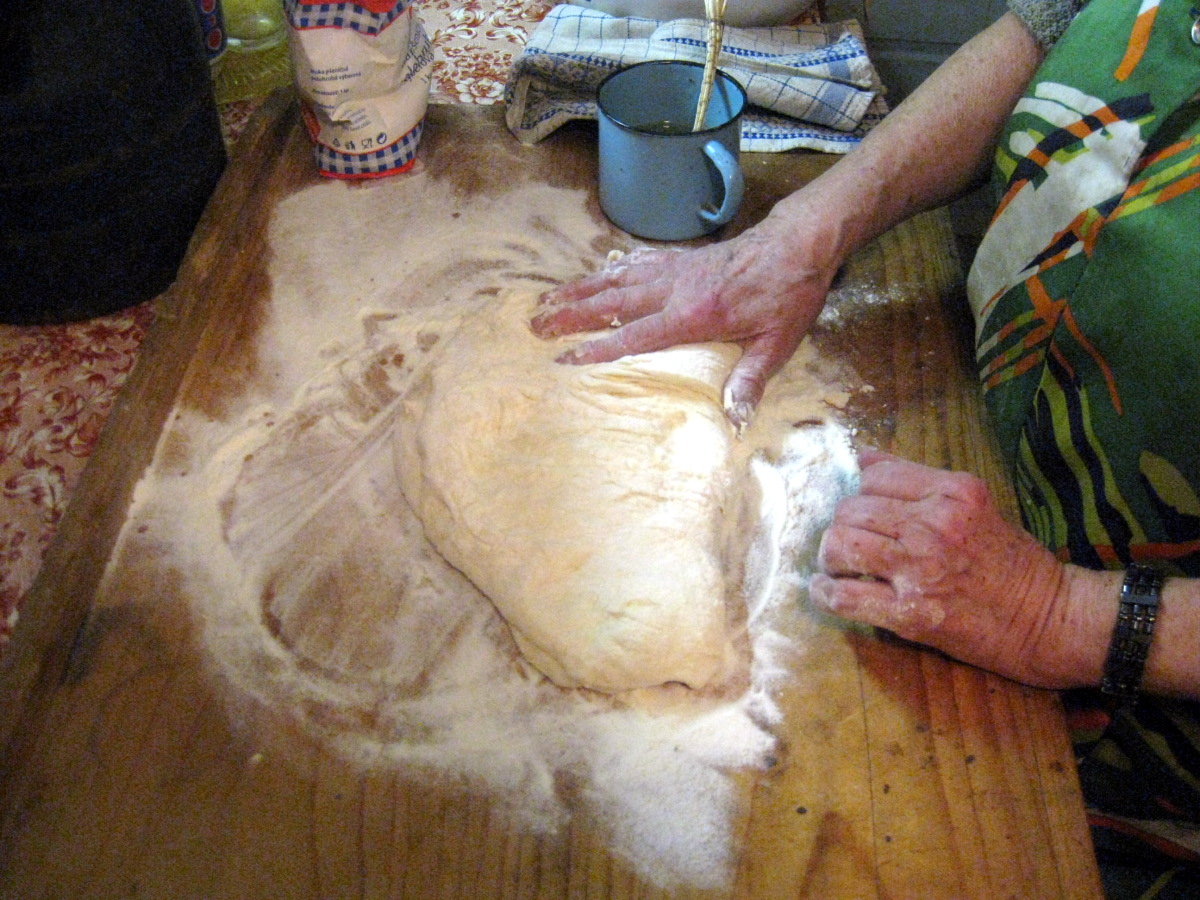

Then fold the dough over, flatten out with hands, and grease again.
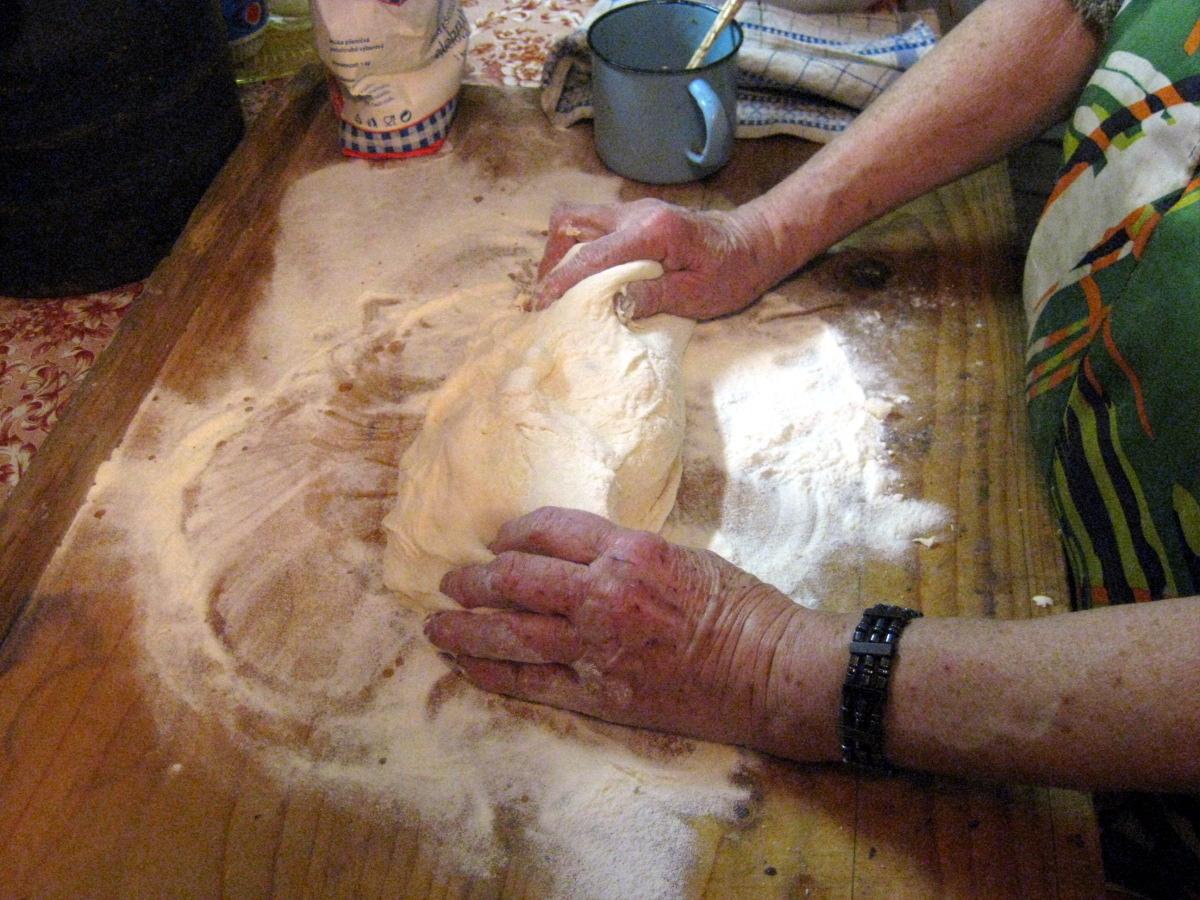
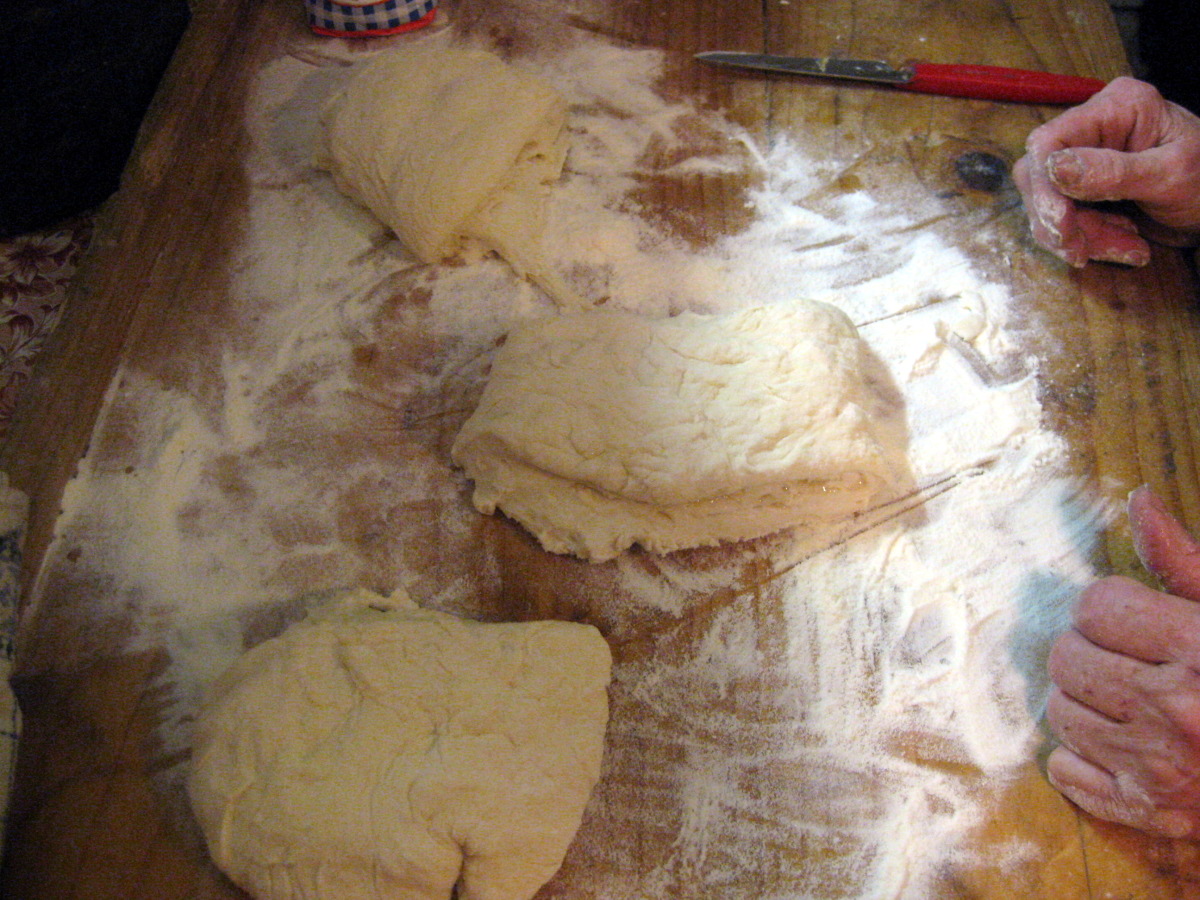
Then again fold the dough over. Form it into a uniform bun and cut it into two or three pieces. Each of these will become an individual cake.
When you were documenting the recipe for the cesto, did you notice the weight on the packet of baking powder? This kind of packaging is not too common where I live–baking powder is usually sold here in little boxes or plastic containers from which the powder is measured by the spoonful. Because the baking powder provides the leavening for the dough, the exact amount might be critical for good results. Love your website! B. J.
I did not, but if I remember right, it was about two tablespoons worth. I’ll try to get the weight next time I visit my grandma.
Online references say on packet baking powder is equal to one tablespoon.
Hi there,
I have this same baking powder (but it is labeled Backin where we live – Switz). There is no weight on the label, but I weighed it and it is 16g. The reverse also says “for 500g flour”
Hope that helps.
Zabka
In reference to B.J.’s question:
The packet of DrOetker baking powder pictured above is 12 grams.
It is a type that contains starch, I think Amazon sells it too.
Hello, I found exactly the same brand of the baking powder at home and a packet weights 12 grams.
It’s great that you promote our slovak cuisine, which is quite unknown abroad.
Thanks for the recipes, your grandma probably loves passing them on too. I’m gonna make the raisin bread for my Slovakian girlie, yay. :o)
Thanks Daisy! Yup, she loved having me around. I figured it’s the least I can do for her.
Hello,
I can not express how much this website has brought joy to my heart, thank you. Today is the first time to enjoy it. I found you through the Jednota paper. I miss my family’s cooking and this has encouraged me to continue to teach my children of their heritage. You have opened up a whole new world for us. I can’t wait to label things in the pantry to practice the language with my kids! I am so grateful for your efforts , and know we will be a regular visitor to your site. Thank you for sharing your family with ours. With appreciation, s.p.
Stephanie, thank you for your wonderful comment. You totally made my day!
I make vianocka once a year at Christmas time. My recipe (in original slovak book) doesn’t call for baking powder – I wonder how it would be with it.
By the way you can buy fresh yeast in North America, you can get it in any bakery or some special store – I buy it at Italian store. Fresh yest works much better than dry one. I buy it, weigh it into 50 g portions (good for 1 kg of flour) and freeze it.
I agree Mira, fresh yeast has a sweeter/pleasant taste vs. dried that can have a strong aftertaste in my opinion. I remember reading that fresh yeast has let off the gases vs. dried. I suggest if you use dried yeast you let the dough rise an extra time to let off some of the extra gases.
Here is a link for others trying to find fresh yeast. Most healthier grocery stores sell fresh yeast too, Whole foods, Trader Joes… this link gives some additional ideas on how to buy it and where locally
http://www.thefreshloaf.com/node/14313/how-make-fresh-yeast-cake-yeast
Veľmi sa mi páči táto stránka 🙂
Vo štvrtok si spravím aj ja vianočku :-))
I do not have a comment on the ‘buchty’ recipe yet – but intend to make them this week.
You always write about problem getting poppy seed here in the U.S. Whenever I go to Slovakia I always bring my self a supply. A friend of mine was there in March and she brought me back quite a supply of “mlety mak” – expiration on it is 2nd October 2010. Next time you go there to visit you should do the same.
That’s a really good idea. Just to make sure it wouldn’t cause any problems at the airport, I went to the CBP (customs) website, and looked for list of prohibited items. According to the website, “You may bring bakery items and certain cheeses into the United States”. I would definitely consider poppy seeds as “bakery item”.
And Dagmar, remind what was your comment on “buchty”.
Thanks Lubos,
Ive been studying your website for 3 hours now and feel like making all the recipes right away;)
It’s so important so not to stop making your own food especially with all the influences in North America. It brings me joy!
I completely agree. Thanks for stopping by the site!
Hi.
I’m from England, and we have a 9 year old Slovakian girl staying with us for the summer. Her dad is in the country working where i do and desperately wanted her to come over to help her learn the language and suchlike. I cannot thank you enough for the recipes here, as i was a bit nervous that our notoriously bad cuisine would send her screaming for home ( i dislike it, so i would understand completely ) I love to cook but couldn’t find any decent amount of traditional Slovak recipes until i found your site, so now i can get to work and try to make her stay here a little more comfortable. Keep up the good work, these recipes are making my mouth water now.
Hi, how much yeast would a packet be? Is it the same as the 12g baking powder packet?
That’s right, at least that’s what I substitute when making this. I use one packet of “rapid-rise yeast”.
1 packet = 2 1/4 tsp
you are all wrong about this recipe , you are way off on the amount of flour you say 1/2 of a 1 kilo bag is about 8 cups wrong ! 8 cups is almost 2/3 of a 5 lb. bag ( 2 kilos ) so you are telling us to use more than 1 kilo of flour.
i sugest , next time you go to the old country you take american measuring untensils and get the correct amounts .
i was really exited about finding this recipe , but very disappointed about the outcome !
Hi John, the cups in this case likely refer to the drinking mugs – I mentioned that in some other recipe but don’t remember which one. Thank you for noting this.
The greatest lesson I learned from watching my grandma is that it’s not the measurements that matter, it’s knowing what the dough should look like. And to be honest with you, this leavened dough is the single most difficult item on this site so far. It took me at least half a dozen of attempts to finally get it right. Next time you make it, do not worry so much about the amounts, but do pay attention to the consistency of the dough. It’s very important that it is as shown in the photo above where my grandma is pulling on it with her hand. It should be sort of like honey – definitely NOT so stiff that it holds shape of a loaf easily. Also make sure it’s sweet enough to your liking.
You work in the rest of the flour only after the dough rises. You work in just enough so that you can work with the dough without it sticking to your hands. Then make sure to grease and fold several times, this is what will give it that fluffy consistency.
If you have any more questions, feel free to shoot me an email.
Just so you know, 1 cup of unsifted American all-purpose flour = 125 grams.
Thanks for the lovely recipes!
Great. I just made the dough with 8 cups and it’s extremely dry. I kept adding water. The dough is hard and lumpy. I’ve waisted a lot of time and am extremely disappointed since it’s the holidays.
Boo!
N
I think it’s a mistake, it should be 4 cups not 8 cups (she said about half of the 2lbs pocket) and that is 4 cups. I did it today and it worked out great.
You should build your own site Mr Wonderful
I agree with you, John. The proportion of flour to the rest of the ingredients is wayyy off. You can try as hard as you want to work the rest of flour into the dough, and you still end up with a tough, dry mess and frustration. I ended up throwing it all out. The amount of flour needs to be cut by at least half. One pound of flour is about 4 cups, not 8 cups.
I bake ALOT and often make Slovak recipes. Doing the conversion to grams is easiest using a weight scale (sm kitchen scale). Most scales have oz. and grams so you can go back and forth. Actually using weight is the most accurate way to bake. I even use it in my american recipes. The first time I make a new recipe I just weigh out the ingredients and make a note next to the recipe and then can use my scale the next time. It makes a big difference when having to measure shortening, butter… messy ingredients. You can buy a scale for $10-30, even Wal-mart sells them. Also different items weigh differently, a cup of flour is different them a cup of butter.
Hi Sabina! I agree it’s best to use a scale to measure the exact ingredients. Cooking is an exact science. For best results a good chef always measures precisely & accurately. Also, using only the freshest & high quality ingredients gives a superior end product.
Hi Margitka! I agree with you that in a professional setting, it’s important to measure ingredients precisely every time. But at the same time, I don’t like calling cooking “exact science”. I think cooking should be fun and liberating. Measuring everything precisely every time takes that fun away, at least for me, making it feel more like a chore. Granted, things don’t always end up tasting great, but with experience, I am sure I’ll get the gist of it. Not sure if you saw my little ramble in the intro to the scrambled eggs with mushrooms recipe, but that’s what Slovak cooking means to me. It’s the cooking the way of my grandmother, who hardly ever measures anything (some baking excluded, talking mainly about cooking and things like this leavened dough here), uses only very simple kitchen equipment, yet can create some of the most delicious dishes I have ever eaten. Just my two cents…
Lubos, I agree with you. My grandmother came from Slovakia, and when she baked, she never used measuring cups or spoons. It was a creative activity, in which she was in touch with the dough and developed it intuitively. She was a master chef, and her food was out of this world!
Thank you for posting the recipe for the poppy seed cake , many years ago i would make this cake with my grandmother and have looked to duplicate the recipe for some time with not a lot of success. Brings back memories
Baking is a science. Cooking is not. When cooking the amount of ingredience can be varied to suite your taste (it is a guide. However, in baking the ingredience must and should be as recipe calls for.
But how could science ever come up with anything new if there were no experiments…
I totally agree! You can do something according to the instructions, but it will never be as satisfying as if you figure it out on your own…
I just recently found your site and was very pleasantly surprised. Thanks so much for promoting “recepty starych materi” and other traditional slovak recepies. I can’t wait to try some. I am more of the baker than cook, so i really appreciate your receipies for all sweet treats
I love your website. My grandmother used to make an easter bread that was a sweet bread dough like this one but filled and rolled with dried cottage cheese, rasins, and lemon zest. The dough was spread out, filled and rolled up into a round glass cake pan. Do you know of or are aware of any bread like this?
Hi Diane, I am bit confused 🙂 Was it rolled up like a poppy seed roll? Or was it layered and baked in a cake pan like the Christmas Eve cake?
Diana, usudzujem, že by mohlo ísť o kysnutú bábovku. Na Slovensku na Záhorí sa na Veľkú noc pečie takzvaný kugluf. Základom je kysnuté koláčové cesto, rozvaľká sa, posype namočenými hrozienkami a zroluje sa. Vymastíme bábovkovú formu, vložíme zrolované cesto, konce spojíme, potrieme olejom a necháme podkysnúť. Pečieme, kontrolujeme špáradlom, či je cesto upečené. Na Veľkonočný pondelok raňajkujeme kugluf, údené maso a vajíčka uvarené na tvrdo. Kugluf pečieme spolu s koláčmi, keď asi 1/3 cesta z koláčov odoberieme na prípravu kuglufa. Názov je prevzatý z nemčiny, lebo naši predkovia zo Záhoria chodili do Rakúska za prácou.
Makový kugluf z internetu.
http://www.glazir.hr/Poppy_kugluf/267/Default.aspx
if anyone does alot baking one would know then you add your flour a little at a time. 8 cups 6 cups dosen’t matter. all flours arenot made equal. But your eyes and the feeling on your hands are.
we make our dough a little differently using eggs and some melted butter and use a mixing machine with dough hooks and we dont brush with oil. we also rise the dough twice.
Dala som sa do kysnuteho cesta (tomu som sa doteraz nevenovala, ved’ mama to robi vyborne, tak naco? 😉 ) a zaujalo ma, ze tvoja stara mama, dava don aj prasok do peciva. Vies vysvetlit’ preco? Cesto viac narastie, alebo…? U nas sa totiz take cesto bezne robi iba s kvasnicami. Mam kopu visien a chcem urobit nieco podobne tvojmu marhul’ovemu kolacu ale neviem, ci dat’ aj ten prasok do peciva, ci nie. 🙂
Baking powder is not necessary, sufficient yeast. The dough is given so that the cake was more durable. However, it is provided.
Thanks you so much for all the recipes. Just reading them brings back so many fond childhood memories of my grandma and her cooking…especially the nut roll. (She was born in Pennsylvania to Slovak immigrants.) Grandma taught me to make some simple Slovak recipes and I hope to continue passing them on to my children. Thank you!
what dough would you recommend to make “pig in a blanket”? I tried some doughs wrapped around weiners, but did not like it… Thank you so much, Aysa
Aysa, tu som našla nejaké “prasa v deke”. Môže byť?
http://www.searchgrid.org/index.php?lang=sk&cat=406&month=2011-01&id=38815
Joys, there is a recipe for “Parky klobasky” obalene v cesticku.
I can’t find a recipe but i think that’s what Aysa was looking for. I kind of remember eating it when I was a child but don’t know what daugh was used.
hey, I may have found the recipe in my good “Slovanska Kucharka”
Parky v zemiakovom ceste ” Weiners in potatoe daugh”
1 lb potatoes
150 gr of flour
1/4 lb of weiners
4 tablespoon of oil
1 egg
boil the potatoes, skin them, shred ot mash them, add flour, egg, salt, make a daugh.
Roll it into and cut it into squares, fillit with weiners cut into 1 and 1/2 pieces, wrap it and fry it.
Not sure that’s exactly what Aisa was looking for but there ir is.
Ja by som navrhovala párky v lístkovom ceste.
http://www.vseovareni.cz/recepty/parky-v-listovem-teste2/
Našla som zaujímavý recept od nejakej mojej rodáčky. http://varecha.pravda.sk/recepty/hriesne-parky/19933-recept.html
Dobrý môže byť aj tento recept: http://www.webrecepty.sk/recept/165/Parky-v-cesticku.html
Spôsobov na párok v cestíčku je niekoľko, snáď si Aysa vyberie ku svojej spokojnosti.
Joy …”Prasa v deke”? nebo “PRSA” v deke?
Prasa = PIG (animal)
PRSA = Chicken Breast
Thank you so much for all the wonderful recipes. My Mom was not much of a cook and didn’t get many “recipes” from my Grandma. It is so great to have the recipes for the nut and poppy seed rolls. I can’t wait to make them!! It brings back so many wonderful memories of my Grandparents and the happy days at their house on Sundays and holidays. Thank you so much again.
I see where some may say adjustment is needed in the recipes. You call for 1 pound of flour.. it is no where near 8 cups. 8 cups of flour yields almost 2 kilo’s of flour or 4 and 1/2 pounds. Is the recipe for the levened dough supposed to read 1 kilo?
Hi Helena, I made the correction to 2lbs from 1lb.
My Grandparents were from Czechoslovakia so was thrilled to find this site. I remember many of these recipe’s from my Grandma. I would like to make a small donation to your site but would prefer to mail a cheque.
Thank You,
MaryAnn
I would love to make the recipe for the leavened dough but it seems really messed up as far as how much to use of the ingredients. They say use half of a 2 pound bag of flour yet at the top of the page is says 2 pounds of flour. Can anyone help in giving an exact recipe and the precise amount of ingredients. Thank you.
This recipe came out beautifully!! Thank you sooo much! I loved seeing tvoja stara mama making the dough. It was very helpful. I grew up watching my mom make these rolls around the holidays; now it’s my turn to bake for her as she now longer is able to do so. What a blessing this website is! Thanks again.
Just returned from Bratslava….did not find anything like my Grandmother (Zuzzanna Zachar), used to make….She was a baker before immirating to the US. Her poppy seed roll was the best that I have ever tasted but I can not replicate. The dough was very thin with dozens of layers with the poppy seed paste very thin. the dough could not have been more than 1/8 at the most….ring a bell for anyone? Most everything that I found was a very cakey or bread like dough…just does not tast the same.
Hi PJ, there are two types of poppy seed roll. One is this bread-like one, which is what is shown on poppy seed roll recipe page. The other one is made from strudel (puff-pastry) dough. That’s similar to the easy apple strudel, except that you use the poppy seed mixture for the filling.
By the way, I found the rolls your describe at the bus station in Poprad this past summer.
Apple strudel with poppy
http://varecha.pravda.sk/recepty/jablkovy-zavin-s-makom-/5689-recept.html
Hi, my Grandma was from Bratislava also. Came her when she was 25 with a 2 year old. She was a fabulous cook and made a huge pan of Kolace every time we visited. Her’s were just like you described. Never a recipe for anything, they learned from their mothers. Nothing was written back in the day. She lived til she was 101 and even tho they ate rich food, she doesn’t remember a sick day in her life. She never wrote down any recipe because that’s not how they cooked, so Mom and I experimented until we got it almost like hers. I use dough hooks (a Godsend) and put cream cheese in the dough and they are very delicious and flaky. Grandma’s poppyseed filling was fabulous. Mom and I mix them with a little cream and sugar & vanilla and they’re pretty good. I like the Solo apricot the best. My mother is going to be 94 on Thanksgiving and I love to make them for her for christmas. I am teaching my granddaughter how to make then now.
The dough you mention sounds like a strudel dough. My Mother in law mad this pastry, a real art, it was so thin you could see through it. It was pulled to fit bigger than dinning table , then spread with fillings such as poppyseed, cheese and dried fruit and also ground nuts. You can purchase phylo dough in grocery store and using layers brushed with butter to make almost like home made dough.fFill as desired and roll , brush with butter and bake.
My Stara Mama just passed away yesterday. And I kept thinking of her awesome poppy seed rolls. So since I cannot make it to her funeral I will be making these rolls! So glad I came across this awesome site!!! Thank you so much. I will cook and bake to grow closer to her!
Elenka, úprimnú sústrasť.
The modern version of this using cream cheese is ok…BUT nothing was greater than the smell of my mother cooking these when I was little…she used my grandmother’s ( her Mom’s) recipe old world style using yeast…can’t believe I found this..never seen this on Martha Stewart or Paula Deen…or any of the new cook books….what a treasure..can’t wait till the holidays to make them…..
This is wonderful! My Slovak Oma died many years ago and left no recipes behind. Her daughters all learned to cook by remembering the taste & smell of her foods. The family was from Nova Spisske Ves region. Our favorite meals were always peasant food! I am dreaming of KRAUT PELTSCH (peltch?) and GREISS PELTCH for over 20 years. Does your Oma know this? The kraut (cabbage)was sliced,fried then kneaded into the potato/egg/yeast(?) dough. It was rolled out to fit a large cookie sheet, baked, cut into 7cmX9cm pieces, lathered with milk&honey&butter mixture. OH MY GOD>>>YUMMY! The Greis (cream of wheat) was cooked then worked into the dough before baking in a cookie sheet, etc. My Mom never made it, my aunts are all gone. HELP!
Good evening lady, Spiš population was of German origin. Food find on Google called “kraut peltch”.
Yes. They spoke and wrote German in the village (Svedlar).Of course they spoke many other languages as well (Hungarian, Polish, etc) but what I learned recently is that there was/is a local dialect called SLOVAKISCH. My youngest aunt still remembers some of it. I speak English, German, French, Spanish. My mind is not mathematical but for language, sewing, cooking and logical thinking I’m very good.
Suzanne, I am not good at baking, but this looks close to what you are talking about.
I know the final baking and preps looks different but I don’t see reason why you could not spread it on a baking sheet and cut it into pieces after you are done.
Maybe somebody knows more about this. I just tried to help.
http://www.slovakheritage.org/Recipes/kapustniky.htm
cheers
http://www.slovakheritage.org/Recipes/kapustniky.htm
Thanks, Miro. The recipe link is for something totally different. What you suggested is for a version of perogy, tasty but not what I’m looking for. KRAUT PELTCH & GREISS PELTCH has either pan fried cabbage sliced thin or cooked cream of wheat mixed into the flour/dough. Thanks for trying.
Hi Suzanne, I posted your question to the Facebook page, but no solid leads yet but some possibilities. Do any of them sound familiar?
Suzanne, perhaps a cabbage roll, kapustový závin? This was suggested by somebody on Facebook.
Looks delicious but not the right thing. The sauteed cabbage is kneaded into the raw dough then rolled out to 2cm thick, placed on a cookie sheet and baked. When done, it’s like a flat bread. Cut into squares, then brushed (or dipped into) warm mixture of honey&butter. Instead of cabbage one could use cream of wheat (griess, auf deutsch).
Thanks for trying, Lubos. I fear this recipe is perhaps one my Oma invented and never shared. She learned to cook in Hungary where she was billeted while going to school.
I will have to experiment in the kitchen.
I have also been trying to make the cabbage recipe you are talking about…we think our grandmother called it hodzimka. Have no idea how to spell it. does this sound familiar to anyone? Fried cabbage in between 2 layers of dough like a pizza OR fried cabbage put on a circle of raw bread dough, gather up like a bag then roll it out. Bake and put brush with browned butter.
Can you give a better measurement of how much baking powder to add?
I found that if you 1/2 the recipe, you can put it in the bread machine on dough cycle! Super and less work!
Hello, my grandmother used to make both the poppy seed and almond roll and since her passing my father has missed these dearly. I haven’t been able to find a good “dough” recipe and am eager to attempt this one, especially with the fresh yeast. Thank you for posting with pictures! Unfortunately I can’t get my hands on my grandma’s cookbook so my questions for you are…what type of flour is your grandmother using (all-purpose), how much fresh yeast (1oz?)and do you/grandma have a good recipe for PAGACHI?
Thanks in advance!!
Lubos – can’t wait to try your recipes here. To be honest, we’re planning a family get-together to learn to make nut rolls. Merry Christmas and thank you!
My Grandmother added 6 egg yokes to the dough. better texture.
I have “The Anniversary Slovak-American Cook Book” edited by The First Catholic Slovak Ladies Union in 1952. The many recipes for nut roll dough often contain 1 lb. of butter, or a pint of sour cream, a quart of sweet cream, and as many as 8 whole or separated eggs. Your recipe seems much healthier. Is the dough dry for lack of any of those ingredients?
Thank you! I have been craving these. I am so glad I found your site. Please send my thanks and kindest wishes to your babka!
Zabka
Gotta say the milk in these photos looks much healthier than the processed chemicals we buy here. I can only imagine how good this tastes, I fondly remember my grandmother making strudel and poppy seed cookies from long rolls of dough at her kitchen table. She grew the poppy seeds and anything else she needed and we always fought over who got to grind the seeds for baking:) Love your site, my mother turned me on to it and though she lives thousands of miles away it has given us another bonding moment, so thank you again:)
“kynuté těsto” 😉
This was traditional for my family at Christmas, my grandparents came to America from Miyava Slovakia and I keep the tradition and make this every year. I have some trouble with the loaf getting flat or bursting open but the taste is one that always reminds me of Christmas Eve dinner. Thank you for sharing!
Greetings from Las Vegas! I lived in Slovakia and the Czech Republic for about six years in the 90s and truly appreciate this website. My Cousin shared it with me after finding it to make langoš. I have made the langoš as well and did a couple of loaves of the Vanočka for Christmas. Cheers!
Ocistite boky misy a sustredte cesto v strede. Pomucte, zakryjte a odlozte na teple miesto. Nechajte kysnut asi jednu hodinu, alebo kym cesto nezdvojnasobi svoj objem.